Research-first guide
Should Sake Be Served Hot or Cold?
Both. Temperature is a flavor choice, not a quality ranking. The useful question is what you want to notice in this bottle, with this food, on this pour.
External evidence
JSS, NRIB, and sensory research
Field observation
First-hand Enrai notes, not a controlled test
The direct answer
Sake can be served chilled, at room temperature, or warmed. The Japan Sake and Shochu Makers Association (JSS) describes all three as normal service categories, and its service manual covers a wider traditional range from about 5°C to 55°C.
None of that creates a ladder from cheap hot sake to expensive cold sake. A cool pour may protect delicate fruit and floral aromas. A warm pour may shift attention toward sweetness, rice-like aroma, savory depth, structure, or alcohol heat. The direction and usefulness of the change still depend on the bottle.
The sake temperature scale
These names describe approximate liquid temperature. Measure the sake itself—not just the warmer setting, the water bath, or the outside of the vessel.
| Temperature | Japanese term | English explanation | What to watch for |
|---|---|---|---|
| 5°C / 41°F | Yuki-hie 雪冷え | Very cold; aroma can be quiet and the texture can feel dense. | Fine detail may be harder to notice. |
| 10°C / 50°F | Hana-hie 花冷え | Clearly chilled; a useful starting point for fresh or aromatic profiles. | Notice whether fruit and floral notes stay defined. |
| 15°C / 59°F | Suzu-hie 涼冷え | Lightly chilled; aroma and flavor have more room to open. | Compare it with the same sake at 10°C. |
| 20°C / 68°F | Room temperature 室温 / hiya | Neither refrigerated nor warmed; a distinct serving category in sake. | In sake usage, hiya can mean room temperature, not chilled. |
| 30°C / 86°F | Hinata-kan 日向燗 | Gently warmed, with little sensation of heat or cold. | Look for subtle shifts before stronger warming. |
| 35°C / 95°F | Hitohada-kan 人肌燗 | Near body temperature; rice and koji-like aromas may become easier to notice. | Separate aroma character from total aroma intensity. |
| 40°C / 104°F | Nuru-kan ぬる燗 | Warm rather than hot; sweetness, savoriness, and balance may become easier to read. | Do not assume acidity has simply become weaker. |
| 45°C / 113°F | Jo-kan 上燗 | Noticeably hot; aroma and flavor can feel more concentrated or firm. | Check bitterness, dryness, and alcohol heat. |
| 50°C / 122°F | Atsukan 熱燗 | Hot sake in the specific temperature sense, not a name for every warmed pour. | Aroma may sharpen and alcohol can become more prominent. |
| 55°C+ / 131°F+ | Tobikiri-kan 飛び切り燗 | Very hot service at the top of the traditional range. | Alcohol sting can overwhelm balance; hotter is not automatically better. |
Temperature names: JSS, “日本酒のおいしい飲み方.” Main service ranges: JSS, “How to Serve Sake.”
What temperature changes—and what it does not
Baseline vs observation
A bottle's TasteScore remains its baseline profile. We do not automatically convert that score at each temperature. A measured tasting at 10°C, 20°C, 40°C, or 50°C is a separate Temperature Observation with its own method and evidence level.
Temperature changes perception; it does not rewrite where the original score came from. When a bottle is shown with a TasteScore, its provenance still matters. Read the full verification tiers on our Methodology page.
Temperature through the six TasteScore dimensions
These are observation prompts, not formulas. The National Research Institute of Brewing separates aroma, taste, mouthfeel, and aftertaste in its sensory vocabulary; the same separation keeps temperature notes from collapsing into one vague idea of “fuller.”
Sweetness
JSS guidance says sweetness can become easier to perceive as sake approaches body temperature.
That is a tendency, not a promise that every bottle will taste sweeter when warmed. Acidity, alcohol, and aroma can change the overall impression at the same time.
Observe: Record perceived sweetness and whether it feels integrated, exposed, or balanced by acidity.
Aroma
Warming can reduce delicate fruit and floral expression while making rice, cereal, or steamed-grain notes more noticeable.
Do not turn this into one aroma score moving up or down. Total intensity and aroma character are different observations.
Observe: Track total aroma, fruit/floral aroma, and rice/cereal aroma separately.
Body
Warm sake can feel fuller in flavor while becoming less physically viscous.
Flavor fullness and texture are not the same measurement. A broader flavor does not necessarily mean a thicker liquid.
Observe: Record flavor weight and physical viscosity as two fields.
Acidity
Temperature can change both acid intensity and the quality of the acidic impression.
In a 2009 sensory study, some acids and model mixtures tasted more intense when warm while also being described as smoother or more harmonious. Stronger and rounder can coexist.
Observe: Track strength, freshness, sharpness, roundness, and balance—not just ‘more’ or ‘less.’
Umami
JSS guidance says umami can become easier to detect near body temperature.
A warmer pour does not create a new TasteScore or guarantee more umami in every bottle. Bottle-specific tasting takes priority.
Observe: Record savory intensity, food interaction, and whether umami improves or burdens the balance.
Finish
Temperature can shift the dry or crisp impression, bitterness, finish length, and alcohol heat.
At very hot temperatures, alcohol sensation can dominate. A sharper finish is not automatically a cleaner or better finish.
Observe: Track length, crispness, bitterness, and alcohol heat separately.
Acidity: intensity and quality are different
This is where simple warm-sake advice breaks down. A JSS beginner guide summarizes acidity as unaffected by heat. A more specific 2009 sensory study tested individual organic acids, a three-acid mixture, and a model sake system across temperatures.
Compared with 20°C, lactic acid tasted significantly more intense at 37°C and succinic acid at 50°C. The main three-acid mixture and the model sake system were significantly more acidic at 43°C. Yet panelists also described warm samples as smooth, rounded, or harmonious. Malic acid, by contrast, had a fresh, clean quality at 10°C.
The practical lesson is not “warming increases acidity.” It is that acid composition, intensity, and quality can move differently. Compare the bottle in front of you at measured temperatures.
How to choose your starting temperature
Sake Coordinates editorial starting points
Start with a profile, not a grade. The ranges below are comparison plans—not automatic TasteScore cutoffs and not claims that every bottle in a category behaves the same way.
| Profile | Start here | Why | Then test |
|---|---|---|---|
| Aromatic + light | 8–12°C | A cool starting point helps preserve delicate fruit and floral detail. | Let the glass rise toward 15–20°C; try gentle warmth only as a deliberate comparison. |
| Bright acidity + light body | 10–15°C | Cool service can retain a fresh, clean acid impression. | Compare with 20°C and 40°C; note acid strength and acid quality separately. |
| Balanced / moderate | 15–20°C | Room temperature exposes the baseline without strong chilling or heating. | Move one pour down to 10°C and another up to 40°C. |
| Restrained aroma + more body or umami | 20°C | Room temperature gives a neutral reference before warming. | Try 35–45°C and watch flavor fullness, texture, and savory balance. |
| Structured + savory | 35–40°C | Gentle warmth may make the structure and savory character easier to read. | Compare with 45–50°C; stop if alcohol or bitterness takes over. |
| Aged / mature | 15–20°C | A neutral start helps you identify nutty, dried-fruit, spice, and mature aromas. | Warm in small steps; mature styles vary widely. |
| Sparkling | Well chilled | Heating releases dissolved carbon dioxide and flattens the sake. | Do not heat it. |
8–15°C
Chilled sake
A practical start for light, fresh, or aromatic profiles. Fruit and floral detail may stay clearer, while strong chilling can make subtle sweetness and umami harder to see.
15–25°C
Room temperature
Its own category, not an unfinished step between cold and hot. In sake, hiya can mean room temperature rather than refrigerated sake.
30–55°C+
Warm sake
Hinata-kan, hitohada-kan, nuru-kan, jo-kan, and atsukan are not interchangeable. Move in small steps and stop when alcohol or bitterness begins to dominate.
What our field notes show
First-hand observationAt Enrai in Shibuya, two sake were served heated. Fusozuru Junmai Ginjo Omachi stayed gentle, with soft rice umami and restrained acidity. Izumibashi Kuro Tombo Kimoto Junmai moved in another direction: body, acidity, and umami came further forward.
The clearest match of the visit was Kuro Tombo with ayu confit. That is useful evidence that two bottles can respond differently to warm service and food. It is not a controlled temperature experiment: the exact liquid temperatures were not measured, so we do not assign 40°C, 45°C, or 50°C after the fact.
Read the full Enrai field notes.
How to warm sake at home
Water bath
Pour sake into a heat-safe vessel. Heat water to just below a boil, turn off the heat, and immerse the vessel carefully. Warm gradually and measure the liquid with a digital thermometer. This makes gradual warming and direct temperature checking straightforward.
Microwave
Use a microwave-safe vessel and short heating intervals. Stir between intervals to redistribute hot spots, then measure the liquid. Do not rely on one fixed time: wattage, volume, vessel shape, and starting temperature all matter.
Dedicated sake warmer
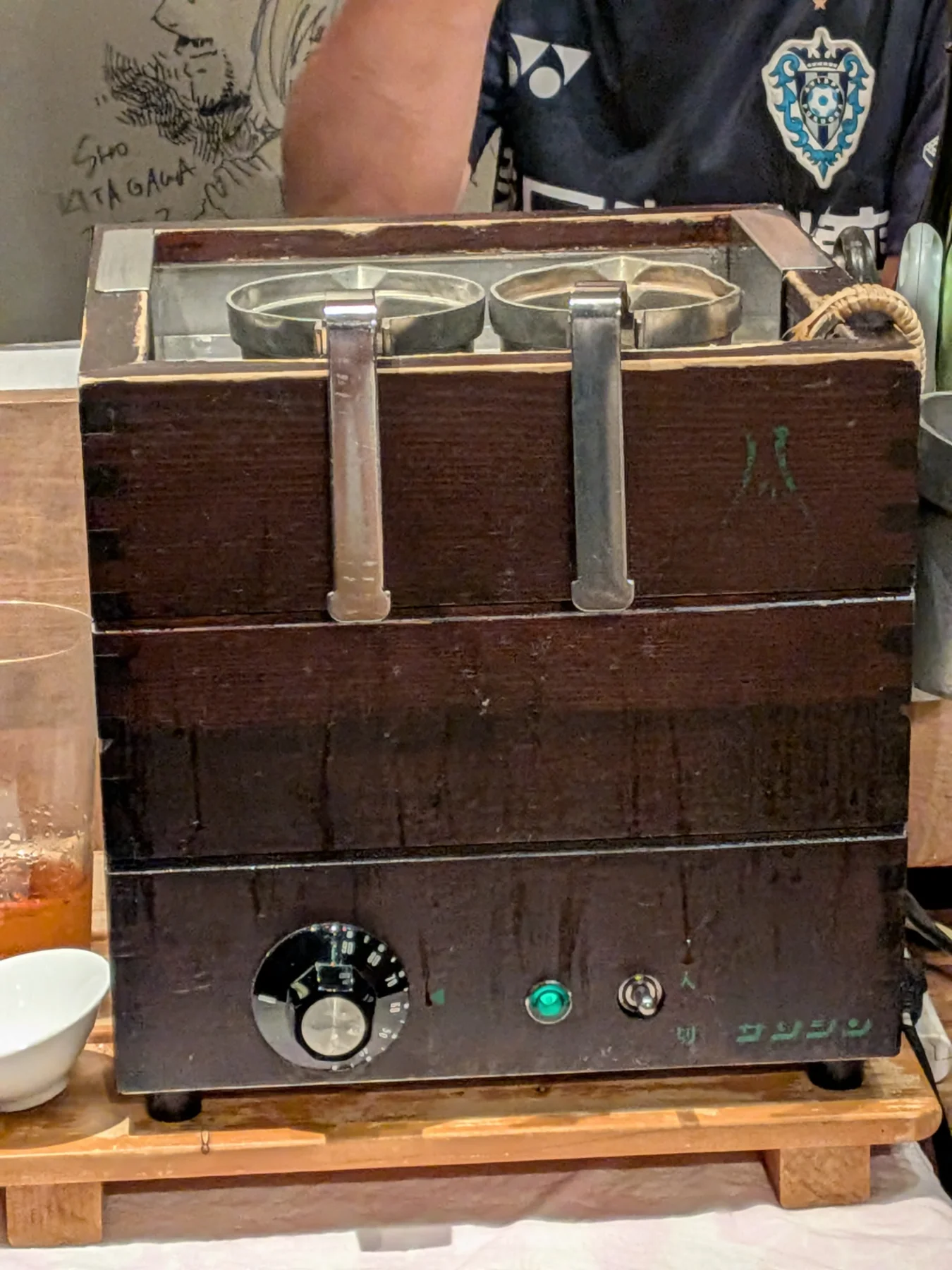
Treat the device setting as a target or control, not proof of the liquid temperature. Measure the sake itself, record the device setting separately, and check more than one point if the vessel may heat unevenly.
Do not heat sparkling sake. Handle hot water and hot vessels carefully, and follow the vessel and appliance manufacturer's instructions.
Common mistakes
- Expensive sake must be cold.
- Warm sake means low quality.
- Junmai is always better warm.
- Ginjo should never be warmed.
- Hotter is better.
- Hiya always means chilled.
- Warming always reduces acidity.
- One temperature tells you everything about a bottle.
FAQ
Should sake be served hot or cold?
Both can be correct. Sake can be served chilled, at room temperature, or warmed. The useful choice depends on the bottle's aroma, body, acidity, umami, finish, and the food—not its price or prestige. Start with the producer's guidance when available, then compare small pours at different temperatures.
What temperature should sake be served at?
JSS groups common service into chilled at 8–15°C (46–59°F), room temperature at 15–25°C (59–77°F), and warmed at 40–50°C (104–122°F). Those ranges are starting points rather than universal rules. The traditional Japanese scale also names smaller steps from 5°C to 55°C and above.
What sake is best served warm?
There is no category-only answer. A sake with restrained aroma, body, acidity, savory depth, or a food-oriented profile may be worth testing warm, but the result must be judged bottle by bottle. Brewery guidance and measured comparison are more reliable than assuming every junmai, kimoto, yamahai, or honjozo belongs at one temperature.
Can premium sake be served warm?
Yes. Price, polish ratio, and premium positioning do not decide serving temperature. Some aromatic sake loses delicate fruit or floral detail with heat, while another carefully made bottle may become more expressive when gently warmed. Temperature is a flavor choice, not a quality ranking.
Can ginjo or daiginjo be served warm?
Sometimes. Chilled or cool room-temperature service is a sensible starting point for highly aromatic ginjo and daiginjo, because heat can suppress delicate fruit and floral aromas. JSS also notes that gentle warming can work for some examples. Test a small pour instead of treating the category as an absolute rule.
Is junmai sake better warm?
Not automatically. Junmai describes ingredients, not one flavor profile or one ideal temperature. Some junmai is savory and structured; some is light or aromatic. Use the bottle's actual profile and producer guidance, then compare measured temperatures before deciding.
What is atsukan?
Atsukan is sake served at about 50°C (122°F). It is one point on the warm-sake scale, not a generic label for every heated sake. Nuru-kan at about 40°C and jo-kan at about 45°C can produce different aroma, texture, acidity, and alcohol impressions.
What is nurukan?
Nuru-kan is gently warmed sake at about 40°C (104°F). It should feel warm rather than sharply hot. This temperature is useful for comparison because sweetness and umami may become easier to notice without the stronger alcohol sensation that can appear at hotter service.
Can I microwave sake?
Yes, if you use a microwave-safe vessel and work in short increments. JSS recommends stirring after heating because microwaves can create uneven hot spots. Measure the liquid with a thermometer; wattage, volume, and vessel shape make fixed timing unreliable.
Can sparkling sake be heated?
No. JSS advises against heating sparkling sake because warming releases dissolved carbon dioxide and leaves it flat. Keep it chilled and follow the bottle's opening and serving instructions.
Does warming make sake less acidic?
Not as a universal rule. A 2009 sensory study found that certain organic acids and model sake mixtures could taste more intense at warm temperatures while also being described as smoother or more harmonious. Acid intensity and acid quality are different observations, and the bottle's acid composition matters.
Continue exploring
References and sources
Industry guidance gives the service framework. The academic study is used specifically where acid intensity and acid quality need more precision. Field observations are labeled separately above.
- 01 Japan Sake and Shochu Makers Association — How to Serve Sake
Used for: Main serving ranges and home warming methods
- 02 Japan Sake and Shochu Makers Association — What Does Sake Taste Like?
Used for: Sweetness, umami, aroma, and texture tendencies
- 03 Japan Sake and Shochu Makers Association — Enjoy Warm Sake
Used for: Temperature names, alcohol sensation, sparkling sake, water bath, and microwave guidance
- 04 Japan Sake and Shochu Makers Association — The Sake Manual
Used for: 5–55°C service range and temperature-specific sensory context
- 05 National Research Institute of Brewing — Sake sensory terminology and reference standards
Used for: Sensory vocabulary for aroma, taste, mouthfeel, and finish
- 06 Shimazu et al. (2009) — Effect of Drinking Temperature on the Acidity of Organic Acids in Sake
Used for: Acid intensity and acid-quality distinction