Label-reading decision guide
How to Read a Sake Label
You do not need to memorize every Japanese term on a sake bottle. Start with the exact product, category, polishing ratio, ingredients, alcohol, and any process terms such as nama or kimoto. Treat SMV and other numbers as clues—not verdicts. A label tells you how a sake was made; the full taste still needs a bottle-specific profile.
Start here
The 30-second label scan
Use the label in this order. Each step answers one practical question and keeps you from asking a production term to do more than it can.
Who made it, and which bottle is it?
Match the brand, product name, brewery, and exact edition. Similar names can hide different rice, polishing ratios, pasteurization choices, or releases.
Category or special designation
Read Junmai, Ginjo, Daiginjo, or Honjozo as a production family. Do not decide the flavor—or the winner—yet.
Rice polishing ratio
Read the number as what remains. A 60% ratio means 60% remains and 40% was removed.
Ingredients
Look for rice, rice koji, and, where used, brewing alcohol. Water is used in brewing but is generally omitted from Japan's ingredient line.
Alcohol
ABV tells you strength. It may affect your experience, but it does not automatically become the TasteScore Body value.
Process or condition terms
Notice terms such as nama, nama-chozo, genshu, kimoto, and yamahai. Each is a clue with a limited definition.
Optional analytical numbers
SMV and acidity can add context when shown. They are not required on every label, and neither converts directly into TasteScore.
Storage and serving instructions
Follow the producer's bottle-specific guidance, especially for nama sake and any refrigeration warning.
Production map, not ranking
What the special designations actually mean
Japan's current rules define eight special designations by ingredients, polishing, koji-rice share, production method, and stated aroma or appearance requirements. A brewery may display a designation when the sake qualifies, but the name is not a universal quality ladder.
| Label term | Rice / koji | Brewing alcohol | RPR requirement | What it tells you | What it does not tell you |
|---|---|---|---|---|---|
| Junmai | Rice + rice koji | No | No numerical minimum | A rice-and-koji special-designation family | Automatically rich, dry, or full-bodied |
| Tokubetsu Junmai | Rice + rice koji | No | 60% or less, or an explained special method | Junmai plus the applicable special requirement | One specific taste or a universal upgrade |
| Junmai Ginjo | Rice + rice koji | No | 60% or less | Junmai ingredients plus ginjo production requirements | Guaranteed sweetness or fruity intensity |
| Junmai Daiginjo | Rice + rice koji | No | 50% or less | Junmai ingredients plus the stricter daiginjo requirements | Automatically better for you |
| Honjozo | Rice + rice koji + brewing alcohol | Yes, limited | 70% or less | A defined non-Junmai special designation | Cheap, diluted, or low quality |
| Tokubetsu Honjozo | Rice + rice koji + brewing alcohol | Yes, limited | 60% or less, or an explained special method | Honjozo plus the applicable special requirement | A fixed aroma, body, or finish |
| Ginjo | Rice + rice koji + brewing alcohol | Yes, limited | 60% or less | Ginjo production and category requirements | Guaranteed sweet or strongly fruity |
| Daiginjo | Rice + rice koji + brewing alcohol | Yes, limited | 50% or less | The stricter non-Junmai daiginjo requirements | The best bottle in every context |
All eight require koji rice to account for at least 15% of the polished-rice weight and must meet the applicable aroma and appearance conditions. Plain Junmai has had no numerical polishing-ratio requirement since the former 70%-or-less rule was removed effective 2004-01-01. For the five most commonly compared names, see Junmai vs. Ginjo vs. Daiginjo.
Read what remains
Rice polishing ratio is not a score out of 100
Rice polishing ratio—seimai-buai—is the weight of the polished white rice compared with the original brown rice. A smaller number means more of the outer grain was removed.
Lower ratios help define Ginjo, Daiginjo, and several other designations. They do not automatically mean a higher TasteScore, higher quality, more sweetness, or more aroma in every bottle.
Ingredient line
Brewing alcohol is not a quality warning
Junmai family
The special-designation ingredient line is rice and rice koji. Water is part of brewing but is generally not listed as an ingredient in Japan.
Non-Junmai family
Ginjo, Daiginjo, Honjozo, and Tokubetsu Honjozo may use brewing alcohol. In specially designated sake, the permitted amount is limited to 10% or less of the polished-rice weight.
The NTA describes brewing alcohol as alcohol fermented from starchy or sugary materials and explains that a measured addition can be used deliberately for aroma and a cleaner profile. Read it as a production choice—not shorthand for diluted, cheap, or bad sake.
Useful process clues
Process terms worth noticing
Nama / namazake
No heat treatment after production. It does not mean sweet. Check the storage warning and keep to the producer's guidance.
Nama-chozo
Stored without heat treatment, then heat-treated when shipped. It is different from fully unpasteurized namazake.
Genshu
No post-production water adjustment, apart from the narrow adjustment allowed under the standard. It may have higher ABV, but it does not guarantee a heavy TasteScore Body.
Kimoto
A starter-method clue that includes the traditional yamaoroshi step. It does not guarantee umami, acidity, or quality.
Yamahai
A related starter method that omits yamaoroshi. It does not guarantee sourness, funk, or heaviness.
For heat-treatment details, read what nama, nama-chozo, and nama-zume mean. For sake brewed with sake in place of some brewing water, read what kijoshu means. For the starter-method distinction, read our focused guide to kimoto versus yamahai. The short version is simple: method clue, not taste guarantee.
SMV and acidity are clues, not answers
Neither number is required on every label. NRIB defines SMV as relative weight compared with water. Sugar affects the result, but alcohol and non-sweet sugars do too; acidity can also mask sweetness.
Use the numbers to ask better questions, then check the bottle's actual profile. Our sweet-versus-dry guide explains the measurement without inventing a conversion to TasteScore.
Current Japanese rule
What changed about manufacturing dates in 2023
Since January 1, 2023, manufacturing-date labeling has been optional under Japan's sake quality-labeling rules. Before that date, it was a required item under this standard. The current NTA rule takes priority over older explainers that still show the former requirement.
When shown, the manufacturing date refers to when the sake was filled and sealed for sale. Do not automatically read it as the brewing year, a wine-style vintage, or proof of storage quality. Its absence does not tell you that a bottle is old or suspicious.
Owned, tracked example
Read a real label—and stop where the photo stops
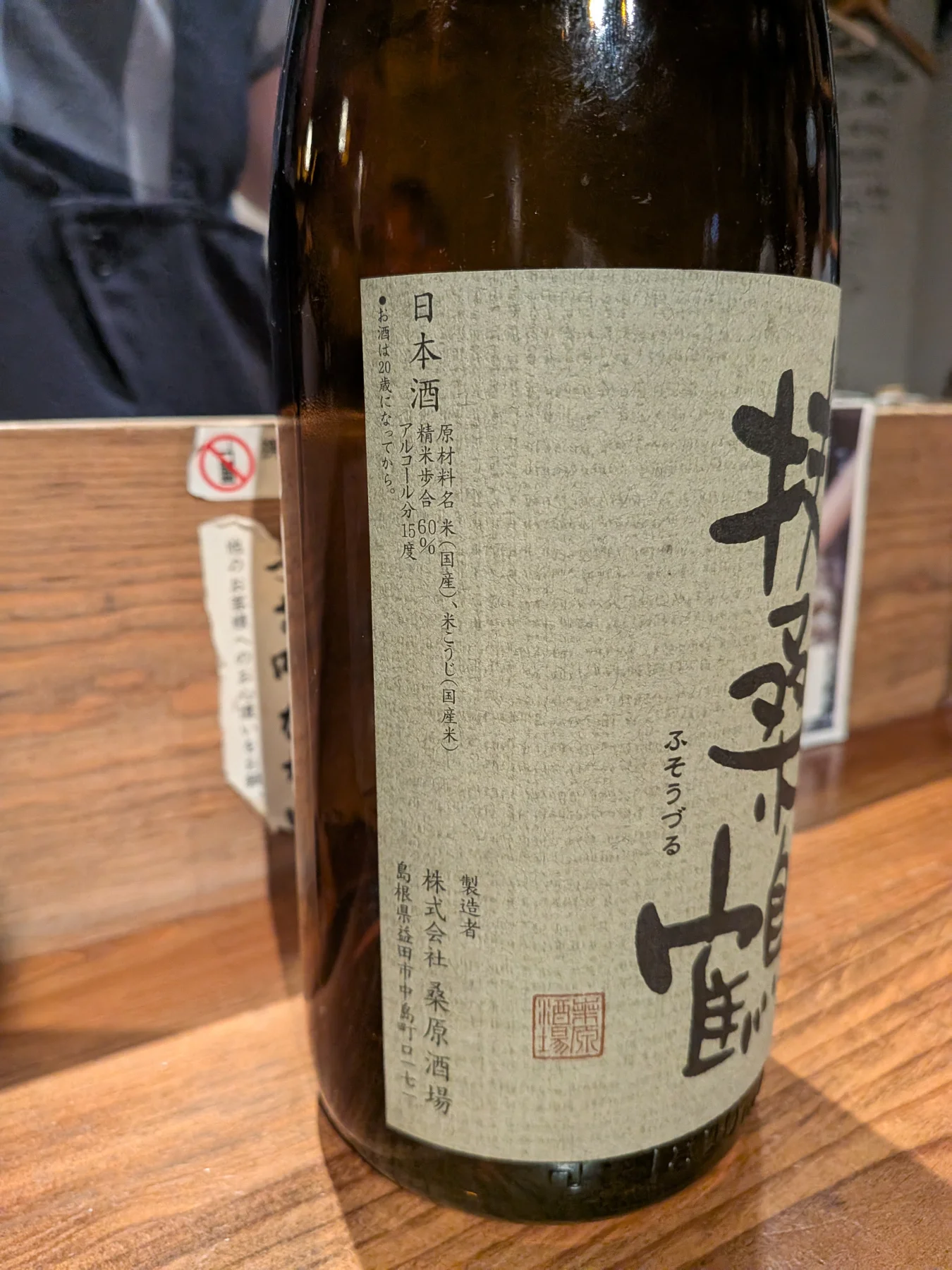
This front-label photo is an existing Sake Coordinates project asset from the Enrai Journal. The reading key names only text visible in this crop; it does not invent a back label.
Visible reading key
- 01Identity: Fusozuru product/brand mark.
- 02Product class: 日本酒 (nihonshu).
- 03Ingredients: rice and rice koji, both marked domestic.
- 04Rice polishing ratio: 60% remains; 40% removed.
- 05Alcohol: 15% ABV.
- 06Producer: Kuwabara Sake Brewery in Shimane.
- 07Safety statement: alcohol is for people age 20 and over in Japan.
Not clearly visible here: SMV, acidity, storage directions, and any additional process information. Those fields are not annotated.
Three separate layers
Label facts are not TasteScore
Each example keeps currently audited production facts, the six-axis profile, and our editorial interpretation separate. The provenance badge tells you whether the profile has been human-reviewed or remains AI-assisted research.
2 · TasteScore
3 · Editorial reading
Junmai and Kimoto describe production facts, not a fixed flavor. This bottle's profile sits at Sweetness 3 with Body, Acidity, and Umami all at 4.
2 · TasteScore
3 · Editorial reading
Honjozo tells you that limited brewing alcohol is permitted. Its centered Body and Acidity scores show why that ingredient is not a quality warning or a flavor verdict.
2 · TasteScore
3 · Editorial reading
Junmai Ginjo does not force a light profile. This bottle's current research profile puts Body at 4 and Finish at 4.
1 · Label / spec facts
- Category
- Junmai Daiginjo
- RPR
- 50%
- ABV
- 17%
- Process
- Genshu · aged 3 years
2 · TasteScore
3 · Editorial reading
Junmai Daiginjo does not guarantee delicate weight or dryness. This aged genshu currently sits at Sweetness 4 and Body 4.
Compare the full collection on the Taste Map, read the six axes in What Does Sake Taste Like?, and check how TasteScore provenance works.
Sake Coordinates editorial reading priority
What matters most when choosing a bottle
High, Context, and Optional are editorial priorities—not scientific scores. “High” means the field is usually worth checking early, not that it predicts taste by itself.
| Label information | How useful? | Use it for | Do not use it for |
|---|---|---|---|
| Exact product identity | High | Avoid mixing up similar names or releases | Assuming every bottle under a brand is the same |
| Category | High | Identify the production family | Ranking quality or predicting the full flavor |
| Ingredients | High | See whether brewing alcohol is listed | Treating brewing alcohol as a defect |
| Rice polishing ratio | High | Understand how much rice remains and category eligibility | Using the number as a score out of 100 |
| ABV | High | Gauge alcohol strength | Converting it directly to Body |
| Nama / genshu | Context | Understand heat treatment, dilution, and storage needs | Assuming sweet or heavy |
| Kimoto / yamahai | Context | Identify starter method | Assuming umami, acidity, or funk |
| SMV | Optional | Add a density-based sweet/dry clue | Calling +5 guaranteed dry |
| Acidity | Optional | Add analytical context | Equating it with perceived Acidity |
| Manufacturing date | Context | Read bottling timing when shown | Equating absence with age or poor storage |
| Awards and premium-looking wording | Optional | Investigate a specific claim if it matters to you | Replacing your taste and context with prestige |
Once you have the facts, browse the published sake collection by the flavor and context that matter to you. If you are already at a restaurant, use the izakaya ordering guide to turn flavor, temperature, food, and pour size into a short request.
Quick corrections
Common sake-label misconceptions
A 40% polishing ratio means 40% was removed.
It means 40% of the original brown-rice weight remains; 60% was removed.
A lower polishing ratio always means better sake.
A smaller number means more milling and can satisfy category criteria. It is not a universal quality or preference score.
Daiginjo is always better than Junmai.
They describe different production frameworks. Food, temperature, texture, aroma, and your preferences can make either the better choice for a specific occasion.
Junmai always tastes rich, and Ginjo always tastes sweet.
Neither label fixes a bottle's TasteScore. Category is a production clue; a bottle-specific profile is still needed for sweetness, body, aroma, and finish.
Added brewing alcohol means low quality.
Brewing alcohol is a deliberate, regulated ingredient in non-Junmai special-designation sake. Its permitted amount is limited in that framework.
A positive SMV guarantees dry sake.
Positive SMV often points drier, but alcohol, acids, aroma, texture, and sugar composition affect perception.
Nama means sweet, and genshu means heavy.
Nama describes heat treatment; genshu describes water adjustment. Neither term is a sensory score.
No manufacturing date means the bottle is old or suspicious.
Manufacturing-date labeling has been optional under Japan's sake quality-labeling standard since 2023-01-01.
More Japanese words or gold printing means more premium sake.
Design can help identify a product, but it does not replace category facts, a bottle-specific profile, or storage guidance.
FAQ
Sake label questions
How do I read a Japanese sake label?
Start with the exact product and brewery, then check the category, rice polishing ratio, ingredients, alcohol, process terms, and storage instructions. Treat SMV and acidity as optional clues. The label explains production facts; use a bottle-specific TasteScore or trusted tasting description for the full flavor profile.
What does Junmai mean on a sake label?
Junmai is a special-designation family made with rice and rice koji, without added brewing alcohol. Current Japanese rules do not give plain Junmai a numerical polishing-ratio requirement. Junmai does not guarantee that the sake will taste rich, dry, savory, or full-bodied.
What does Ginjo mean on a sake label?
Ginjo indicates a defined production category using ginjo brewing, a rice polishing ratio of 60% or less, at least 15% koji rice, and the applicable aroma and appearance requirements. Non-Junmai Ginjo may include a limited amount of brewing alcohol. The term does not guarantee sweetness or aroma intensity.
What does Daiginjo mean on a sake label?
Daiginjo follows the ginjo framework with a rice polishing ratio of 50% or less and the stricter stated aroma and appearance requirement. Junmai Daiginjo omits brewing alcohol; Daiginjo may use a limited amount. Neither term means the bottle is automatically best for every drinker.
What does rice polishing ratio mean?
Rice polishing ratio is the weight of the polished white rice compared with the original brown rice. A 60% ratio means 60% remains and 40% was removed. A smaller percentage means more of the outer grain was milled away; it is not a score out of 100.
Is a lower rice polishing ratio better?
Not automatically. Lower ratios are part of the legal criteria for Ginjo, Daiginjo, and several other designations, but more milling does not guarantee higher quality, more sweetness, a stronger aroma, or a better match for your taste and food.
Does added alcohol mean low-quality sake?
No. Brewing alcohol is a deliberate and regulated production choice in non-Junmai special-designation sake such as Ginjo, Daiginjo, and Honjozo. Under this framework, the amount is limited to 10% or less of the polished-rice weight. Judge the bottle, not the ingredient alone.
What do nama and genshu mean?
Nama means the sake received no heat treatment after production. Genshu means it was not adjusted with water after production, apart from the narrow adjustment allowed by the standard. Nama does not mean sweet, and genshu does not guarantee a heavy body. Follow bottle-specific storage guidance.
What does +5 SMV mean?
+5 is a positive Sake Meter Value, a specific-gravity reading. Positive values often point in a drier direction, but +5 does not guarantee perceived dryness. Alcohol, acidity, aroma, texture, and sugar composition can change what you taste.
Why is there no manufacturing date on my sake bottle?
Since 2023-01-01, manufacturing-date labeling has been optional under Japan's sake quality-labeling rules. Its absence does not prove that a bottle is old, poorly stored, or suspicious. When a date is shown, it refers to filling and sealing for sale, not automatically the brewing year.
References
Sources and what they support
- National Tax Agency — current sake quality-labeling overview
Used for: Current designations, required and optional items, polishing ratio, brewing alcohol, process terms, and the 2023 date-rule change.
- National Tax Agency — current sake quality-labeling standard
Used for: Regulatory entry point for the current standard.
- National Tax Agency — 2022 amendment comparison
Used for: Primary amendment record and 2023-01-01 effective date.
- JSS — How to Read Sake Bottle Labels
Used for: Eight special designations, ingredients, koji-rice minimum, and optional analytical fields; its production-date requirement is superseded by the NTA amendment.
- NRIB — A Comprehensive Guide to Japanese Sake
Used for: Polishing-ratio explanation, SMV as specific gravity, acidity, and the limits of SMV-only interpretation.
- NRIB — Brewing Terms
Used for: Standard English expressions for label and brewing terminology.
Regulatory statements on this page describe Japan's current domestic sake quality-labeling framework. Labels sold in other countries may also follow local requirements. The JSS English explainer retains the former manufacturing-date rule; the current NTA amendment controls that point here.