Sake brewed with sake—without the shortcuts
What Is Kijoshu?
Kijoshu is a sake style brewed by using sake in place of some of the brewing water, commonly during the final addition to the main mash. That altered fermentation environment often produces pronounced sweetness and richness. But “kijoshu” is a production clue—not a guarantee of one flavor. Bottles can be young or aged, nama or pasteurized, lower or higher in alcohol, and balanced by different levels of acidity.
The precise meaning
What kijoshu tells you
Japan's Tokyo National Tax Agency describes kijoshu as sake made by substituting sake for part of the brewing water. NRIB traces the modern method to the former National Research Institute of Brewing and notes that the idea drew on an older method recorded in the Engishiki.
Kijoshu is not listed as one of the current National Tax Agency's legally defined special designations such as junmai or ginjo. It is better read as a named brewing method and product term. The name is also a registered trademark with a separate industry history. If you found the word on a bottle, use our label guide to read every other field independently.
Inside the mash
How is kijoshu made?
Sake's main mash is normally built in stages. In the method described by the original development study and current brewery pages, sake replaces water at tomezoe, the final addition. The added liquid is sake, not distilled brewer's alcohol.
“Commonly” matters. The historical patent record covers sake replacing all or part of the brewing water, while public explanations usually say part. Read an exact producer's method before turning the standard pattern into an absolute rule.
Fermentation and balance
Why can kijoshu taste sweet?
When sake enters the final mash, alcohol is present earlier than in the standard build. In the original trials, the researchers targeted about 9.5% alcohol in the liquid portion after the addition. The resulting test sake was very low in SMV and rich in extract; later trials also measured substantial reducing sugar.
That supports a brewing explanation for why pronounced sweetness is common. It does not create a conversion formula. Yeast, fermentation progress, acids, alcohol, aroma, and texture all affect perception. Our sweet-versus-dry guide explains why SMV and sugar are clues rather than a complete sensory answer.
No single flavor
What does kijoshu taste like?
Many official and technical sources describe kijoshu as sweet and rich. Beyond that, the useful answer becomes bottle-specific. A fresh nama example can differ sharply from an eight-year-aged bottle in aroma, color, texture, acid balance, and finish.
Aging adds another source of variation. A study of kijoshu stored for 2 to 14.5 years found changes in color, acidity, organic acids, and amino compounds over time. Those chemical changes support a maturation story, but they do not predict one tasting note for every cellar or bottle.
Production term ≠ score formula
Read kijoshu through the six TasteScore axes
Sweetness
Many examples are notably sweet, but analytical sugar, SMV, acidity, and perceived Sweetness are different measurements.
Aroma
Young, nama, and aged bottles can show different aroma character and intensity. The process term sets no Aroma score.
Body
Richness is common in official descriptions, but kijoshu does not guarantee one weight or texture.
Acidity
Acid can be central to balance. Brewing studies also show that yeast choice changes organic-acid results.
Umami
Amino-acid findings in brewing or aging research do not convert directly into perceived Umami.
Finish
An aged, concentrated bottle may finish differently from a fresh nama example. Check the exact profile.
For definitions of the six axes, start with What Does Sake Taste Like?.
One important process change
Kijoshu vs. standard sake brewing
| Question | Standard sake brewing | Kijoshu |
|---|---|---|
| Liquid added during the main mash | Brewing water | Sake replaces some brewing water in the characteristic method |
| Typical timing | Water is used through the staged additions | Sake is commonly used at tomezoe, the final addition |
| Sweetness | Bottle-dependent | Often pronounced, but still bottle-dependent |
| Aging | Young or aged | Young or aged |
| ABV and post-brewing dilution | Check the label | Check the label; kijoshu does not mean genshu |
Method and time are separate
Kijoshu vs. aged sake and koshu
Kijoshu
Describes the brewing method. NRIB explicitly notes both long-aged and nama variations. Hakkaisan's current product page describes a kijoshu bottled before maturation.
Aged sake / koshu
Describes storage and maturation after brewing. A kijoshu can enter this group, but sake made by other methods can be aged too.
A bridge, not an identity
Kijoshu vs. dessert wine
If you drink dessert wine, the role at the table may feel familiar—but the production method is different. Kijoshu is neither Japanese Port nor Sauternes.
| Drink | Production difference | Safe comparison |
|---|---|---|
| Kijoshu | Sake is used in the sake mash in place of some brewing water | Some bottles can occupy a sweet, slow-sipping role |
| Port | Grape brandy is added to stop wine fermentation | A table-role comparison is possible; the production method is not |
| Sauternes | Sweet wine shaped by grapes affected by noble rot | Sweetness may feel familiar; the raw material and method differ |
Published catalog example
One exact bottle, not a forced list
Only one currently published catalog bottle passes the exact-product, official-source, complete-TasteScore, and provenance gates. The build checks stored catalog integrity; the external brewery page was separately re-audited by research on August 9, 2026.
Official facts
Hanahato Kijoshu aged for at least eight years
Kijoshu · at least 8 years aged · RPR 65% · 16.5% ABV
Official product/spec sourceTasteScore
How to read it
Its research profile is very sweet, aromatic, full-bodied, and long-finishing. That shape belongs to this aged bottle; it is not a formula for young kijoshu or the style as a whole.
The official 500ml and 180ml pages currently differ slightly on acidity, and the catalog SMV differs from the producer page. Neither value is displayed here. Production data was not changed in this article PR; a separate data audit is recommended.
Compare published bottles on the Taste Map and review how provenance works.
Bottle first
How to serve kijoshu
There is no universal kijoshu temperature or glass. Start with the exact producer's storage and serving guidance. Nama and pasteurized bottles require different handling, as explained in our nama sake guide.
Because many examples are concentrated, a small first pour is practical. Taste it at the recommended temperature, then notice how Sweetness, Acidity, Aroma, Body, Umami, and Finish change as the pour sits. Do not assume warming is always better.
Not dessert-only
What food goes with kijoshu?
For the Hanahato example
The brewery suggests cheese, foie gras, pork belly, tempura, chocolate, and ice cream. Those recommendations belong to its aged bottle, not every kijoshu.
A general starting rule
JSS recommends matching flavor intensity and also trying contrast—such as sweet sake with acidic or bitter food. Use those as tests, then let the exact bottle decide.
Sake Coordinates Field Note
A fresh kijoshu with a savory appetizer
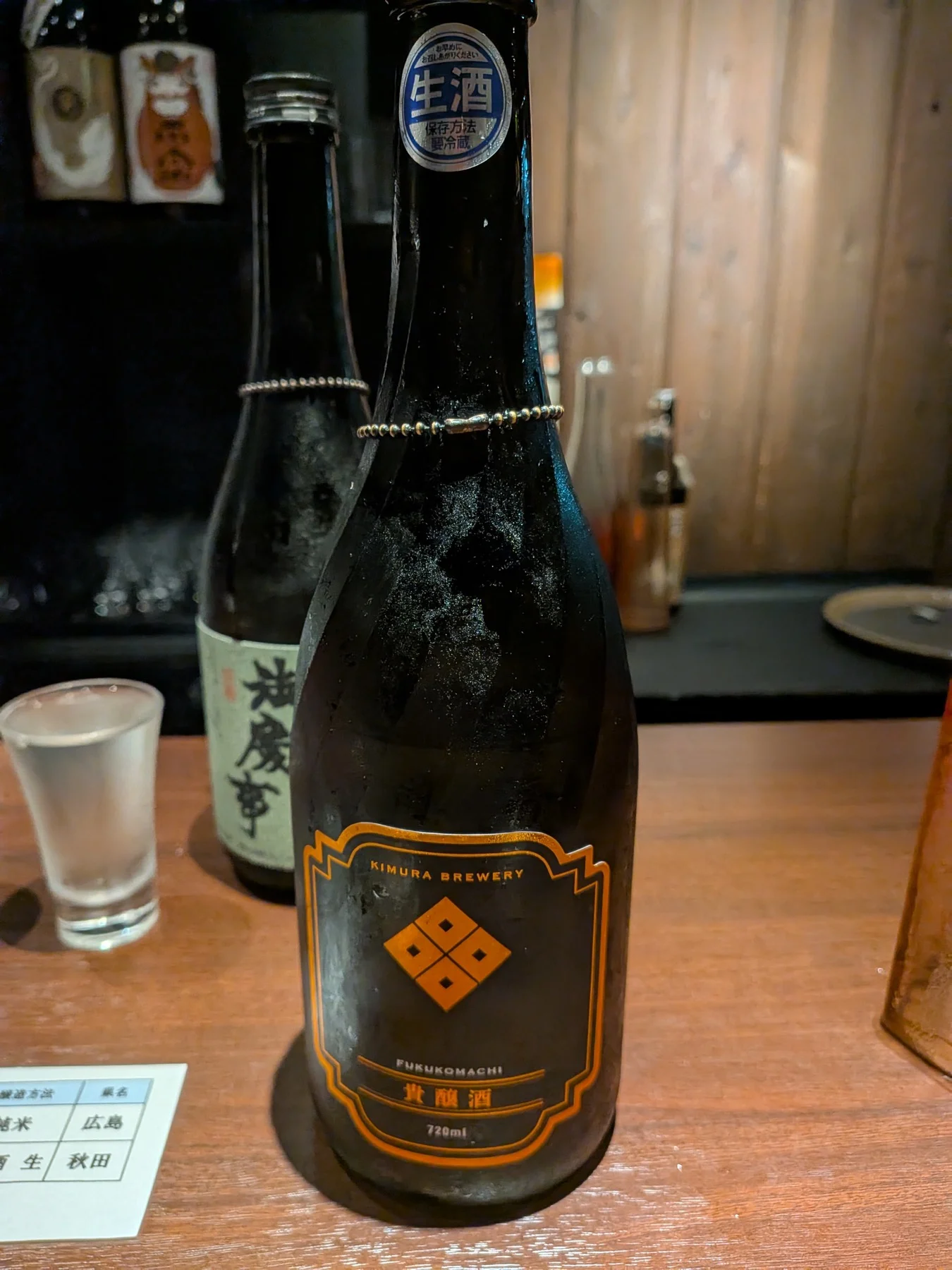
At Kuri Ginza on June 11, 2026, Sake Coordinates tasted Fuku Komachi Kijoshu Nama chilled. Its recorded six-axis profile was 5 Sweetness, 4 Aroma, 3 Body, 3 Acidity, 4 Umami, and 4 Finish.
The standout pairing was sakura-shrimp potato salad: the sake's observed sweetness met the dish's sweet-savory profile. This is a first-hand observation about that exact nama bottle and dish—not evidence that every kijoshu pairs the same way.
A practical buying sequence
How to choose a kijoshu bottle
- 01
Confirm the exact identity
Read the producer, product name, ingredients, and kijoshu process statement.
- 02
Separate the extra axes
Check young versus aged, nama versus pasteurized, genshu, and storage instructions.
- 03
Read the numbers carefully
ABV, RPR, SMV, and acidity can add context without dictating taste.
- 04
Choose by the occasion
Decide whether you want a fresh contrast, a mature slow sipper, dessert, or a rich savory pairing.
Browse all published sake when you want to compare the style with other methods and categories.
Quick corrections
Common kijoshu misconceptions
Kijoshu is always sweet.
Official and research sources support a strong sweet tendency, not a universal sensory score. Read the bottle.
Kijoshu is Japanese Port or fortified sake.
Port is fortified with grape brandy. Kijoshu uses sake in the mash, so the production method is different.
Kijoshu is always aged.
NRIB documents both long-aged and nama variations, and Hakkaisan sells a kijoshu bottled before aging.
Kijoshu automatically means genshu or high ABV.
Genshu concerns post-production water adjustment. ABV remains an exact-bottle fact.
Kijoshu has one TasteScore shape.
Brewing method, analytical chemistry, first-hand notes, and bottle-level TasteScore remain separate evidence layers.
FAQ
Kijoshu questions
What is kijoshu?
Kijoshu is a sake style made by using sake in place of some brewing water during the main mash. The characteristic addition commonly happens at tomezoe, the final stage of the three-step mash build. It is a production clue, not a promise of one flavor, age, alcohol level, or TasteScore.
How is kijoshu made?
In the standard method described by Japanese public and brewing sources, the brewer adds sake to the mash in place of part of the water, commonly during the final addition called tomezoe. Published research also describes variations, so check a producer's exact process instead of assuming every recipe is identical.
Why does kijoshu often taste sweet?
Adding sake changes the fermentation environment. In the original development work, alcohol was already present when the final mash was built, and the finished test sake retained a very low SMV and substantial sweetness. Later trials also measured notable reducing sugar. Acidity and aroma still affect how sweet a bottle actually tastes.
Is kijoshu always sweet?
Do not turn the word into a fixed Sweetness score. Japanese public and industry sources consistently describe sweet, rich tendencies, but recipe, yeast, acid, age, dilution, and serving context can change perception. Treat kijoshu as a useful expectation, then check bottle-specific evidence.
Is kijoshu a dessert sake?
It can work as an after-dinner or dessert-style drink, but that is a serving role rather than a legal category. Producer suggestions and Sake Coordinates' own Field Note also show savory options. Match the exact bottle's intensity and balance instead of limiting kijoshu to sweets.
Is kijoshu fortified sake?
No, not in the technical wine sense. The OIV defines fortification as adding wine spirit or rectified alcohol to wine. Kijoshu is brewed by using sake in the mash. That is also different from adding brewer's alcohol to certain sake categories.
Is kijoshu stronger than regular sake?
Not automatically. Kijoshu describes what enters the mash, not the finished ABV. Published examples vary: the Hanahato bottle shown here is 16.5% ABV, while the separately documented Fuku Komachi Nama Field Note is 13.5%. Read the printed ABV.
Is kijoshu the same as aged sake or koshu?
No. Kijoshu describes brewing; aged sake and koshu describe time and maturation. A kijoshu can be sold young, as Hakkaisan's official page demonstrates, or aged for years, as with Hanahato. Aging can change color, acids, amino compounds, aroma, and texture, but it is an additional axis.
Can kijoshu be nama?
Yes. NRIB's current label glossary explicitly notes both long-term-aged and nama kijoshu variations. Nama concerns heat treatment, while kijoshu concerns the mash. If a bottle combines the terms, follow its refrigeration and handling instructions; our nama guide explains that separate axis.
Can kijoshu be served warm?
There is no reliable universal temperature for every kijoshu. Sake can change with temperature, but a young nama bottle and an aged bottle may need different handling. Start with the producer's instructions. If none are available, try a small pour first rather than assuming warm or chilled is always correct.
What food pairs with kijoshu?
Match the bottle, not only the category. Hanahato's producer suggests cheese, rich dishes, chocolate, and ice cream for its aged bottle. In a separate first-hand visit, Sake Coordinates found a chilled Fuku Komachi Kijoshu Nama worked especially well with sweet-savory sakura-shrimp potato salad.
Does kijoshu need refrigeration?
Kijoshu alone does not determine storage. A nama kijoshu may require refrigeration because it is unpasteurized, while an aged pasteurized bottle may have different guidance. Follow the exact producer label and storage instructions. Do not infer cold storage from the brewing method by itself.
Is kijoshu good for wine drinkers?
It can be a useful discovery for people who enjoy sweet or mature wines, but avoid direct equivalence. Port is fortified with grape brandy, and Sauternes depends on noble-rot grapes. Kijoshu is sake brewed with sake in the mash. Compare table role and balance, then respect the different methods.
References
Sources and what they support
- National Tax Agency — current sake quality-labeling overview
Used for: Legal special-designation, aging, genshu, nama, and label boundaries.
- Tokyo National Tax Agency — sake terminology
Used for: Kijoshu method and development history.
- Intellectual Property High Court — Case No. 2024 (Gyo-Ke) 10075
Used for: Development, naming, Kijoshu Association, registered-trademark, and trademark-management history boundaries.
- NRIB — Japanese sake label glossary
Used for: Method history and young, nama, and aged variation.
- NRIB — Brewing Terms
Used for: English terminology for kijoshu, genshu, koshu, and related terms.
- JSS — Glossary of Sake Terms
Used for: Consumer-facing kijoshu definition.
- JSS — Basic Sake Food Pairings
Used for: General intensity, age, temperature, and contrast pairing principles.
- Journal of the Brewing Society of Japan — original kijoshu development study
Used for: Tome addition, fermentation environment, analytical results, and method limits.
- Journal of the Brewing Society of Japan — high-acid yeast kijoshu trials
Used for: Reducing sugar, organic acids, and yeast-dependent variation.
- Journal of the Brewing Society of Japan — component changes during kijoshu aging
Used for: Aging-related color, acid, and amino-compound changes.
- Hakkaisan Brewery — Hakkaisan Kijoshu
Used for: Current producer evidence for tome brewing and a bottle sold before aging.
- Hanahato / Enoki Shuzo — Kijoshu aged for eight years
Used for: Exact example identity, process, minimum age, RPR, ABV, and producer pairings.
- OIV — Fortification
Used for: Technical boundary between fortified wine and kijoshu.
- Port and Douro Wines Institute — Port Wine
Used for: Port production difference.
- Bordeaux.com — Sauternes
Used for: Sauternes production difference.
Regulatory statements describe Japan's current domestic sake labeling framework. Producer specs and serving suggestions apply to the named bottle and may change. Follow local alcohol laws and the exact producer's storage instructions.