Practical Japan ordering guide
How to Order Sake at an Izakaya
To order sake at an izakaya, you do not need to know every sake category. Tell the staff what kind of flavor you want—light, aromatic, savory, dry, or sweet—then say whether you prefer it chilled or warm and show them what you are eating. Ask, 「おすすめの日本酒はありますか?」 for a recommendation, and confirm the pour size before ordering. The useful skill is describing what you want, not memorizing a label.
The 30-second version
Order your first glass in five steps
Choose a flavor direction
Start with light and clean, fruity and aromatic, savory and umami-rich, or rich and sweeter.
Choose a temperature
Ask for chilled, room temperature, or warm—but let the staff tell you what suits the bottle.
Show them the food
Point to the dish or name it. You do not need to know a sake category first.
Ask for a recommendation
Combine your flavor preference with the food for a more useful answer.
Confirm the pour size
A glass or tokkuri does not guarantee an exact amount. One go is about 180 ml, but not every sake order is one go.
Say what you mean
Use “nihonshu” when you want to be specific
In English, sake usually means the Japanese drink brewed from rice. In Japanese, sake or osake can refer to alcoholic drinks more broadly. Nihonshu makes it clear that you want sake rather than beer, shochu, wine, or another drink.
You do not need to correct a staff member who says sake, and you do not need perfect pronunciation. This distinction is simply useful when a menu lists several kinds of alcohol.
Palate first
Start with flavor, not category
Sake Coordinates maps sake across Sweetness, Aroma, Body, Acidity, Umami, and Finish. At a counter, you do not need to say six scores. Translate the one or two dimensions that matter most into ordinary flavor language.
Light and clean
Ask for: Sukkiri shita mono
TasteScore bridge: Lower Body; often a crisper Finish
Light is not automatically dry, and clean is not lower quality.
Fruity and aromatic
Ask for: Kaori no aru mono
TasteScore bridge: Higher Aroma
Aromatic does not automatically mean sweet.
Savory and umami-rich
Ask for: Umami no aru mono
TasteScore bridge: Higher Umami; Body can vary
Umami-rich does not have to mean heavy.
Rich or sweeter
Ask for: Koku no aru mono or amame no mono
TasteScore bridge: Higher Body and/or Sweetness
Richness and sweetness are separate; say which one you mean.
Learn the axes in What Does Sake Taste Like?, see why dryness is more than SMV, or compare bottles on the Taste Map.
Show or say
Useful Japanese phrases for ordering sake
These phrases use macron-free Hepburn-style romaji so they are easy to type and show on a phone. You can use one phrase at a time; none is a script you must memorize.
おすすめの日本酒はありますか?
Osusume no nihonshu wa arimasu ka?
Do you have a sake you recommend?
- When to use
- Start the conversation
- Caveat
- Add your flavor preference or point to the food for a more useful answer.
辛口をお願いします。
Karakuchi o onegai shimasu.
Dry sake, please.
- When to use
- Ask for a drier direction
- Caveat
- Karakuchi does not tell you the aroma, body, acidity, or finish.
甘めのものはありますか?
Amame no mono wa arimasu ka?
Do you have something on the sweeter side?
- When to use
- Ask for gentle or noticeable sweetness
- Caveat
- Perceived sweetness is not determined by SMV alone.
香りのあるものはありますか?
Kaori no aru mono wa arimasu ka?
Do you have something aromatic?
- When to use
- Ask for a more expressive nose
- Caveat
- This asks for aroma intensity, not one specific fruit or flower.
すっきりしたものはありますか?
Sukkiri shita mono wa arimasu ka?
Do you have something light and clean?
- When to use
- Ask for an easy, clean profile
- Caveat
- Sukkiri and dry overlap sometimes, but they are not synonyms.
旨味のあるものはありますか?
Umami no aru mono wa arimasu ka?
Do you have something savory and umami-rich?
- When to use
- Ask for savory depth
- Caveat
- Umami does not fix the sake's sweetness or weight.
コクのあるものはありますか?
Koku no aru mono wa arimasu ka?
Do you have something richer or fuller?
- When to use
- Ask for more weight or depth
- Caveat
- Koku is a natural request, not an exact TasteScore Body value.
この料理に合う日本酒はありますか?
Kono ryori ni au nihonshu wa arimasu ka?
Is there a sake that goes with this dish?
- When to use
- Point to a dish and ask for a pairing
- Caveat
- The answer will depend on the exact dish and the bottles available that day.
冷酒でお願いします。
Reishu de onegai shimasu.
Chilled, please.
- When to use
- Ask for chilled service
- Caveat
- Check whether chilled service suits and is available for that bottle.
ぬる燗でお願いします。
Nurukan de onegai shimasu.
Gently warm, please.
- When to use
- Ask for a softly warmed serving
- Caveat
- The venue may use its own temperature judgment.
燗にできますか?
Kan ni dekimasu ka?
Can this be served warm?
- When to use
- Ask before choosing a warm temperature
- Caveat
- Not every sake is offered or recommended warm.
小さいサイズはありますか?
Chiisai saizu wa arimasu ka?
Do you have a smaller pour?
- When to use
- Try more than one style at a slower pace
- Caveat
- Small-pour options vary by venue.
半合はありますか?
Hango wa arimasu ka?
Do you offer a half-go pour?
- When to use
- Ask whether about 90 ml is available
- Caveat
- Hango is not offered everywhere.
これは何mlですか?
Kore wa nan-miririttoru desu ka?
How many milliliters is this?
- When to use
- Confirm a glass or carafe size
- Caveat
- Point to the menu item or vessel so kore is clear.
地元の日本酒はありますか?
Jimoto no nihonshu wa arimasu ka?
Do you have local sake?
- When to use
- Look for a regional bottle
- Caveat
- Local availability depends on where you are and what the venue stocks.
季節の日本酒はありますか?
Kisetsu no nihonshu wa arimasu ka?
Do you have a seasonal sake?
- When to use
- Ask what is seasonal now
- Caveat
- A seasonal option may not be available.
もう少し軽いものはありますか?
Mo sukoshi karui mono wa arimasu ka?
Do you have something a little lighter?
- When to use
- Adjust your second order
- Caveat
- Use this after telling the staff what felt too rich or heavy.
| Japanese | Romaji | Natural meaning | When to use | Caveat |
|---|---|---|---|---|
| おすすめの日本酒はありますか? | Osusume no nihonshu wa arimasu ka? | Do you have a sake you recommend? | Start the conversation | Add your flavor preference or point to the food for a more useful answer. |
| 辛口をお願いします。 | Karakuchi o onegai shimasu. | Dry sake, please. | Ask for a drier direction | Karakuchi does not tell you the aroma, body, acidity, or finish. |
| 甘めのものはありますか? | Amame no mono wa arimasu ka? | Do you have something on the sweeter side? | Ask for gentle or noticeable sweetness | Perceived sweetness is not determined by SMV alone. |
| 香りのあるものはありますか? | Kaori no aru mono wa arimasu ka? | Do you have something aromatic? | Ask for a more expressive nose | This asks for aroma intensity, not one specific fruit or flower. |
| すっきりしたものはありますか? | Sukkiri shita mono wa arimasu ka? | Do you have something light and clean? | Ask for an easy, clean profile | Sukkiri and dry overlap sometimes, but they are not synonyms. |
| 旨味のあるものはありますか? | Umami no aru mono wa arimasu ka? | Do you have something savory and umami-rich? | Ask for savory depth | Umami does not fix the sake's sweetness or weight. |
| コクのあるものはありますか? | Koku no aru mono wa arimasu ka? | Do you have something richer or fuller? | Ask for more weight or depth | Koku is a natural request, not an exact TasteScore Body value. |
| この料理に合う日本酒はありますか? | Kono ryori ni au nihonshu wa arimasu ka? | Is there a sake that goes with this dish? | Point to a dish and ask for a pairing | The answer will depend on the exact dish and the bottles available that day. |
| 冷酒でお願いします。 | Reishu de onegai shimasu. | Chilled, please. | Ask for chilled service | Check whether chilled service suits and is available for that bottle. |
| ぬる燗でお願いします。 | Nurukan de onegai shimasu. | Gently warm, please. | Ask for a softly warmed serving | The venue may use its own temperature judgment. |
| 燗にできますか? | Kan ni dekimasu ka? | Can this be served warm? | Ask before choosing a warm temperature | Not every sake is offered or recommended warm. |
| 小さいサイズはありますか? | Chiisai saizu wa arimasu ka? | Do you have a smaller pour? | Try more than one style at a slower pace | Small-pour options vary by venue. |
| 半合はありますか? | Hango wa arimasu ka? | Do you offer a half-go pour? | Ask whether about 90 ml is available | Hango is not offered everywhere. |
| これは何mlですか? | Kore wa nan-miririttoru desu ka? | How many milliliters is this? | Confirm a glass or carafe size | Point to the menu item or vessel so kore is clear. |
| 地元の日本酒はありますか? | Jimoto no nihonshu wa arimasu ka? | Do you have local sake? | Look for a regional bottle | Local availability depends on where you are and what the venue stocks. |
| 季節の日本酒はありますか? | Kisetsu no nihonshu wa arimasu ka? | Do you have a seasonal sake? | Ask what is seasonal now | A seasonal option may not be available. |
| もう少し軽いものはありますか? | Mo sukoshi karui mono wa arimasu ka? | Do you have something a little lighter? | Adjust your second order | Use this after telling the staff what felt too rich or heavy. |
Temperature without the mythology
Chilled, room temperature, or warm?
JSS groups sake service into chilled, room-temperature, and warmed ranges. Temperature can change aroma, texture, sweetness, umami, and finish, but it does not transform every bottle in the same way. Ask what the venue recommends for the exact sake.
Reishu
冷酒Chilled sake
JSS uses reishu for chilled sake, with detailed guides placing it around 5–10°C (41–50°F).
At the table: Reishu de onegai shimasu.
Chilling can change what you notice, but it does not make a sake premium.
Hiya
冷やRoom-temperature sake in many restaurant contexts
Despite the character for “cold,” hiya can mean sake served without warming or refrigeration.
At the table: If the menu says hiya, confirm what the venue means.
Usage can vary; do not translate it mechanically as chilled sake.
Nurukan
ぬる燗Gently warm sake
JSS places nuru-kan around 40°C (104°F).
At the table: Nurukan de onegai shimasu.
Treat the number as a reference, not a temperature you must measure at the table.
Atsukan
熱燗Hot sake
JSS places atsu-kan around 50°C (122°F).
At the table: Ask whether the bottle is available hot.
Atsukan is one warm-sake range, not the name for every warmed serving.
If you see nama on the menu, remember that it describes heat treatment rather than sweetness. Read what nama sake means and why storage guidance matters.
Know what is arriving
How much sake are you ordering?
One go is about 180 ml, but a sake order is not always one go. Some venues sell smaller glasses; others use a tokkuri or an overflow pour. The safest question is simple: how many milliliters is this?
| Menu or vessel | Reference amount | What it means | What to confirm |
|---|---|---|---|
| One go (ichi-go) | About 180 ml | A traditional volume unit used on many sake menus | Confirm whether the menu's serving is a full go. |
| Half-go (hango) | About 90 ml | Half of one go | Ask whether the venue offers it; many do not list it. |
| Glass | Varies | A direct pour, sometimes with an overflow into a saucer or masu | Ask how many milliliters it contains. |
| Tokkuri | Often around 180 ml, but varies | A serving vessel from which sake is poured into cups | Do not assume the vessel name proves the exact amount. |
Let the plate help
Ask what works with the food
JNTO explicitly recommends asking staff for a sake that matches your meal. You can point to the dish and say 「この料理に合う日本酒はありますか?」. If you want to be more specific, notice fat, salt, acidity, sweetness, umami, char, and the intensity of the dish.
Sashimi or delicate seafood
Notice: Fat, salt, and delicate aroma
Try: “Something clean that will not overpower this dish.”
Grilled fish or yakitori
Notice: Char, salt, sauce, and richness
Try: “Something light or savory that works with the char.”
Fried food
Notice: Fat, salt, and the need for refreshment
Try: “Something with a clean finish or bright acidity.”
Fermented or umami-rich dishes
Notice: Miso, soy, pickles, mushrooms, or sake lees
Try: “Something savory enough to meet the dish.”
Richer meat dishes
Notice: Fat, sauce, sweetness, and intensity
Try: “Something with enough body or acidity for this meat.”
For nigiri and sashimi, use the more detailed sushi pairing framework based on fish, fat, rice, and seasoning.
Read only what helps
How to read an izakaya sake menu
A menu may show only a bottle name and price, or it may add brewery, prefecture, category, rice, SMV, temperature symbols, and pour size. Do not expect every field, and do not let one unfamiliar term stop the order.
| What you may see | Use it for | Do not assume |
|---|---|---|
| Brand or bottle name | Identify the exact sake | Point to it if you cannot read or pronounce it. |
| Brewery or prefecture | Find a producer or regional option | Region does not guarantee one flavor. |
| Category | Recognize Junmai, Ginjo, Daiginjo, or Honjozo | Category is not a flavor score or quality ranking. |
| Rice or brewing method | Add context if it interests you | You do not need it for a first order. |
| SMV / nihonshu-do | Get one analytical sweet/dry clue | It does not predict perceived sweetness by itself. |
| Temperature suggestion | See how the venue recommends serving it | Ask when symbols or terms are unclear. |
| Size and price | Know what you are ordering now | The current menu—not a travel guide—is the source of truth. |
For bottle details, use the label guide. If Junmai, Ginjo, and Daiginjo are the unfamiliar terms, start with the category comparison. Production terms explain how a sake was made; they do not replace a flavor conversation.
Field layer
What Sake Coordinates learned from real sake bars
These are dated observations from published Journals, not rules for every izakaya. No ordering dialogue, serving size, or liquid temperature has been added where the visit did not document it.
Kuri Ginza · June 11, 2026
Small pours made comparison practical
Kuri served 60 ml pours. The visit moved through four house pours and one more suggested at the counter, making it possible to compare styles without committing to a large serving.
Evidence limit: This was Kuri's documented format on this visit, not a standard size for izakaya across Japan.
Read the full JournalChigusa, Shinjuku · July 11, 2026
The dish gave the order a direction
Chilled Hitakami Chokarakuchi Junmai worked with Chigusa-maki—tuna, grated yam, and nori—because its dry structure, acidity, and body stayed present without crowding the food.
Evidence limit: The Journal documents the pairing, not the exact words used to order it.
Read the full JournalEnrai, Shibuya · June 6, 2026
Warm was a bottle-by-bottle decision
At this warm-sake specialist, staff judged the serving for each bottle. Two heated sake showed different body, acidity, and umami rather than collapsing into one generic hot-sake profile.
Evidence limit: The liquid temperatures were not measured, so this page does not assign exact numbers to the visit.
Read the full JournalAomoriya, Ikebukuro · July 21, 2026
Regional sake followed regional food
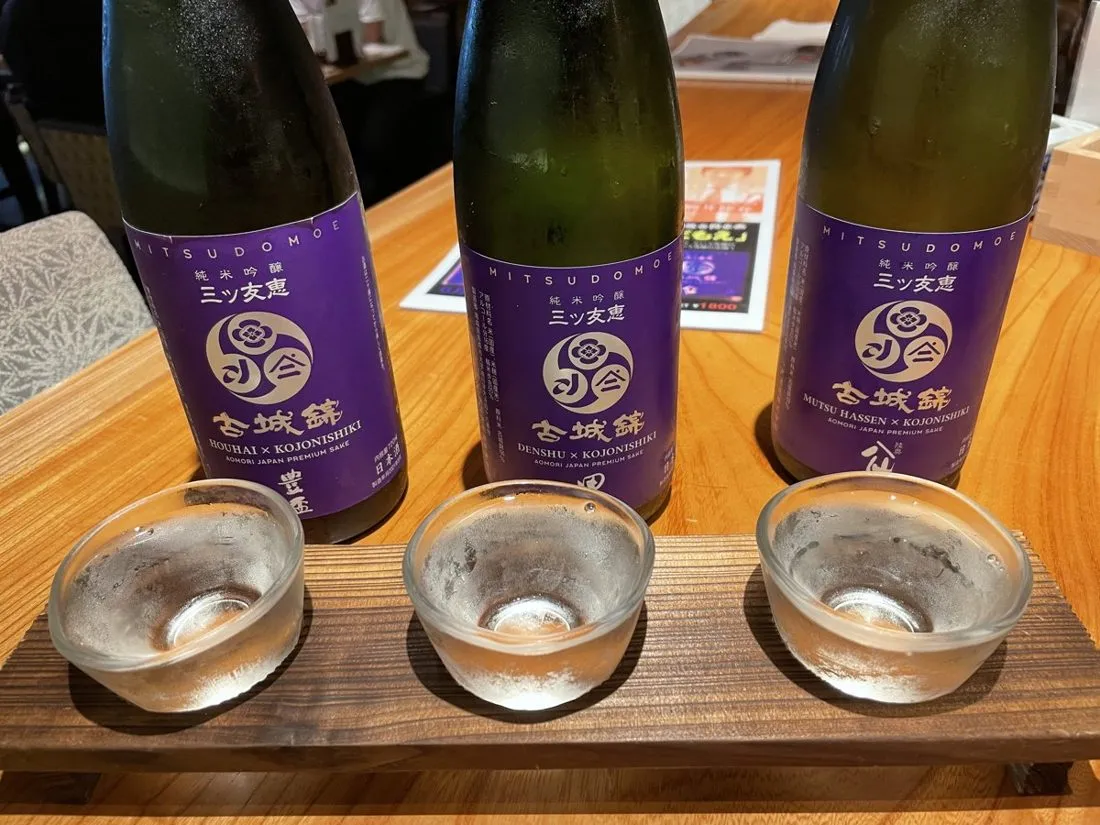
Four chilled Aomori sake took different roles alongside miso, smoked mackerel, sake lees, scallops, pork, and leeks. Asking for local sake and showing the food would have described the useful choice better than asking for the most prestigious category.
Evidence limit: The visit documents four pours with one meal; it does not establish a universal regional-pairing rule.
Read the full JournalA beginner ordering script
From the menu to a second glass
- 1. Pick the food first.
Suppose you order grilled fish.
- 2. Ask for a match.
この料理に合う日本酒はありますか?
Kono ryori ni au nihonshu wa arimasu ka?
- 3. Add a flavor direction.
すっきりしたものがいいです。
Sukkiri shita mono ga ii desu. — I would like something light and clean.
- 4. Confirm temperature and size.
冷酒でお願いします。小さいサイズはありますか?
Reishu de onegai shimasu. Chiisai saizu wa arimasu ka?
- 5. Use the first glass as feedback.
もう少し軽いものはありますか?
Mo sukoshi karui mono wa arimasu ka? — Do you have something a little lighter?
Release the pressure
What not to worry about
- Memorizing every category
- Pronouncing every brand correctly
- Knowing every rice variety
- Understanding SMV before you order
- Remembering the brewery name
- Drinking from one “proper” type of cup
Keep the etiquette small
A practical boundary
- Say kanpai when your group toasts.
- Do not pressure anyone to drink.
- Your drinking pace is personal.
- Ask before assuming a bottle is shared.
- You do not need to follow a universal rule about who pours for whom.
Avoid the shortcuts
Common ordering mistakes
Asking only for “the best” or “the most expensive” sake
Give the staff a flavor, food, temperature, or size preference. Prestige does not tell them what you will enjoy.
Treating karakuchi as a complete flavor profile
Dryness is one dimension. A dry sake can still be aromatic, full-bodied, acidic, savory, or long-finishing.
Assuming cold means premium and warm means cheap
Temperature is a serving choice. The right range depends on the bottle, the food, and your preference.
Ordering every sake hot—or refusing to warm any sake
Ask what the venue recommends for the exact bottle. NRIB notes that not every sake should be heated.
Assuming a tokkuri always contains exactly one go
One go is about 180 ml, but vessels and actual pours vary. Confirm the menu size.
Trying to pronounce every brand perfectly
Point to the menu or ask the staff to show you the bottle. Exact identification matters more than perfect pronunciation.
Turning etiquette into a test
A simple kanpai at the group toast, respect for other people's pace, and asking before sharing a bottle are enough for this decision.
Drink responsibly
Keep water, pace, and the law in the order
Alcohol consumption is prohibited for people under 20 in Japan, even though the civil age of adulthood is 18. Follow the laws that apply to you, eat while drinking, order water, and stop when you have had enough. If you have a food allergy, show the staff the exact dish or ingredient and ask rather than inferring from a sake pairing.
FAQ
Questions about ordering sake in Japan
How do I order sake at an izakaya?
Choose a flavor direction, say whether you prefer chilled or warm sake, show the staff what you are eating, ask for a recommendation, and confirm the pour size. You do not need to know every category or brewery. A useful first request is: “Something light and clean that works with this grilled fish.”
Should I say sake or nihonshu in Japan?
Say nihonshu when you want to be specific. In English, sake normally means Japanese rice-brewed alcohol; in Japanese, sake or osake can refer to alcoholic drinks more broadly. Nihonshu clearly distinguishes sake from beer, shochu, wine, and other drinks.
How do I ask for a sake recommendation?
Ask, “Osusume no nihonshu wa arimasu ka?” Then add one useful clue: dry, aromatic, light, umami-rich, chilled, warm, or the dish you want to match. The more practical context you give, the easier it is for the staff to choose from the bottles available.
How do I ask for dry sake?
Say, “Karakuchi o onegai shimasu.” Karakuchi asks for a drier direction, but it does not specify aroma, body, acidity, umami, or finish. Add another preference if it matters, such as “sukkiri” for something light and clean.
How do I ask for sweet sake?
Ask, “Amame no mono wa arimasu ka?”—“Do you have something on the sweeter side?” This is a flexible request rather than a demand for one category. Perceived sweetness depends on more than SMV, so describing the experience you want is more useful than asking for a number.
What does reishu mean?
Reishu means chilled sake. JSS uses the term for sake served cold, with detailed temperature guides placing reishu around 5–10°C (41–50°F). You usually do not need to order an exact number; ask for reishu and let the venue guide the bottle-specific serving.
What does hiya mean?
In many restaurant contexts, hiya means sake served at room temperature—not refrigerated sake—even though the written word contains the character for “cold.” Usage can vary, so confirm what the menu means instead of translating hiya automatically as chilled.
What does atsukan mean?
Atsukan is hot sake, with JSS placing the term around 50°C (122°F). It is one range within warmed sake, not the name for every warm serving. Nurukan is a gentler warm range around 40°C (104°F).
How much is one go of sake?
One go is about 180 ml, or roughly 6.1 US fluid ounces. It is a traditional Japanese volume unit used for sake. A venue may also sell glasses, half-go pours, or another house size, so confirm the menu instead of assuming every vessel contains a full go.
Can I order a small pour?
Sometimes. Ask, “Chiisai saizu wa arimasu ka?” or “Hango wa arimasu ka?” Sake Coordinates documented 60 ml pours at Kuri Ginza and 90 ml pours at Hinataya, but those are venue-specific examples, not universal izakaya sizes.
What is the difference between a glass and a tokkuri?
A glass is usually a direct serving you drink from. A tokkuri is a carafe-like serving vessel used to pour sake into cups. JSS notes that a tokkuri often holds around 180 ml, but vessel and pour sizes vary, so check the listed milliliters.
Can I ask for sake that matches my food?
Yes. JNTO specifically recommends asking staff for a sake that works with your meal. Say, “Kono ryori ni au nihonshu wa arimasu ka?” and point to the dish. Fat, salt, acidity, sweetness, umami, char, and serving temperature can all help shape the answer.
Do I need to know Junmai, Ginjo, or Daiginjo before ordering?
No. Those terms can add production context, but they do not tell the complete flavor or guarantee quality. For a first order, your preferred sweetness, aroma, body, temperature, food, and pour size are more useful. You can learn the category after you find a glass you enjoy.
Is warm sake lower quality?
No. Warm service is not a quality grade. Some sake is expressive warm, some is better chilled, and some can work across a range. At Enrai, two heated bottles showed very different profiles. Ask what suits the exact sake instead of ranking it by temperature.
Before or after the izakaya
Turn one good glass into a clearer preference
Use the six axes to remember what worked, then compare the published collection by sweetness, aroma, body, acidity, umami, and finish.
References
Sources and evidence boundaries
- JSS — How to Serve Sake
Used for: Chilled, room-temperature, and warmed service; temperature changes perception.
- JSS — Enjoy Warm Sake
Used for: Reishu, nuru-kan, and atsu-kan terminology and approximate reference temperatures.
- JSS — Glossary of Sake Terms
Used for: Tokkuri, masu, warmed sake, and vessel terminology.
- JSS — &Sake: How to Enjoy Sake
Used for: Restaurant vocabulary and traditional sake-volume context.
- JSS — Basic Sake Food Pairings
Used for: Flavor intensity, aroma, temperature, and contrast as pairing starting points.
- NRIB — Pairings
Used for: Food-pairing principles and the bottle-specific limits of heating.
- NRIB — Standard English Expressions for Sake Terminology
Used for: Standard terminology and Hepburn-style romanization context.
- JNTO — Sake 101
Used for: Sake versus nihonshu, one go, vessels, and asking staff for a food match.
- JNTO — Izakaya Dining Guide
Used for: The izakaya dining context and the variety of food and venue formats.
- JNTO — Japanese Sake & Breweries
Used for: Local sake, overflow pours, vessels, and staff pairing recommendations.
- National Tax Agency — Preventing alcohol consumption by people under 20
Used for: Current legal drinking age in Japan.
- SAKE Street — How to Order Sake (industry secondary source)
Used for: Restaurant-context use of hiya for room-temperature sake; supporting context only.
Official sources support general terminology, serving, pairing, and legal claims. SAKE Street is an industry secondary source used only for the restaurant-context meaning of hiya. Dated Sake Coordinates Journals support only the venue-specific observations stated in the four Field Note cards and the Hinataya serving-size example. Current menus, prices, opening hours, stock, English service, and serving formats were not generalized.