Food-first pairing guide
Best Sake for Fried Food: Use Acidity, Body, and Finish to Cut Through Fat
Fried food is not one target. Tempura, tonkatsu, menchi-katsu, and karaage combine different amounts of fat, batter, meat, seasoning, and sauce. Start with the dish's structure, then compare exact bottles instead of choosing by “dry,” Junmai, or acidity alone.
Direct answer
Match the whole fried dish
For fried food, start with Acidity, then match Body and Finish to the weight of the batter, filling, and sauce. Use Umami to connect meat, soy, miso, or savory glaze, and keep Aroma restrained when tempura is delicate. No single category or “dry” label answers all five questions.
Why fried food changes the pairing
Oil coats the palate, but the oil is only the beginning. Batter can be airy or thick; salt can be light or assertive; a vegetable, white fish, minced-meat, or chicken filling changes the dish's weight. Sauce may add sweetness, acidity, miso, soy, or spice.
That is why acidity alone is incomplete. Body decides whether the sake stays audible. Finish describes the contour and resolution of the aftertaste—sharpness, crispness, clean cut, kire, and, when relevant, persistence. Umami can connect savory components, while Aroma can either complement or cover a delicate filling. Learn the full model in what sake tastes like.
Food decision matrix
Tempura, katsu, and karaage need different balances
| Dish | Split the dish | Read these axes | Watch for |
|---|---|---|---|
| Tempura | Light batter; vegetable, shrimp, or white fish | Moderate Acidity, restrained Body and Aroma, and a clean or crisp Finish | Do not let the sake cover a delicate filling just because the batter is fried. |
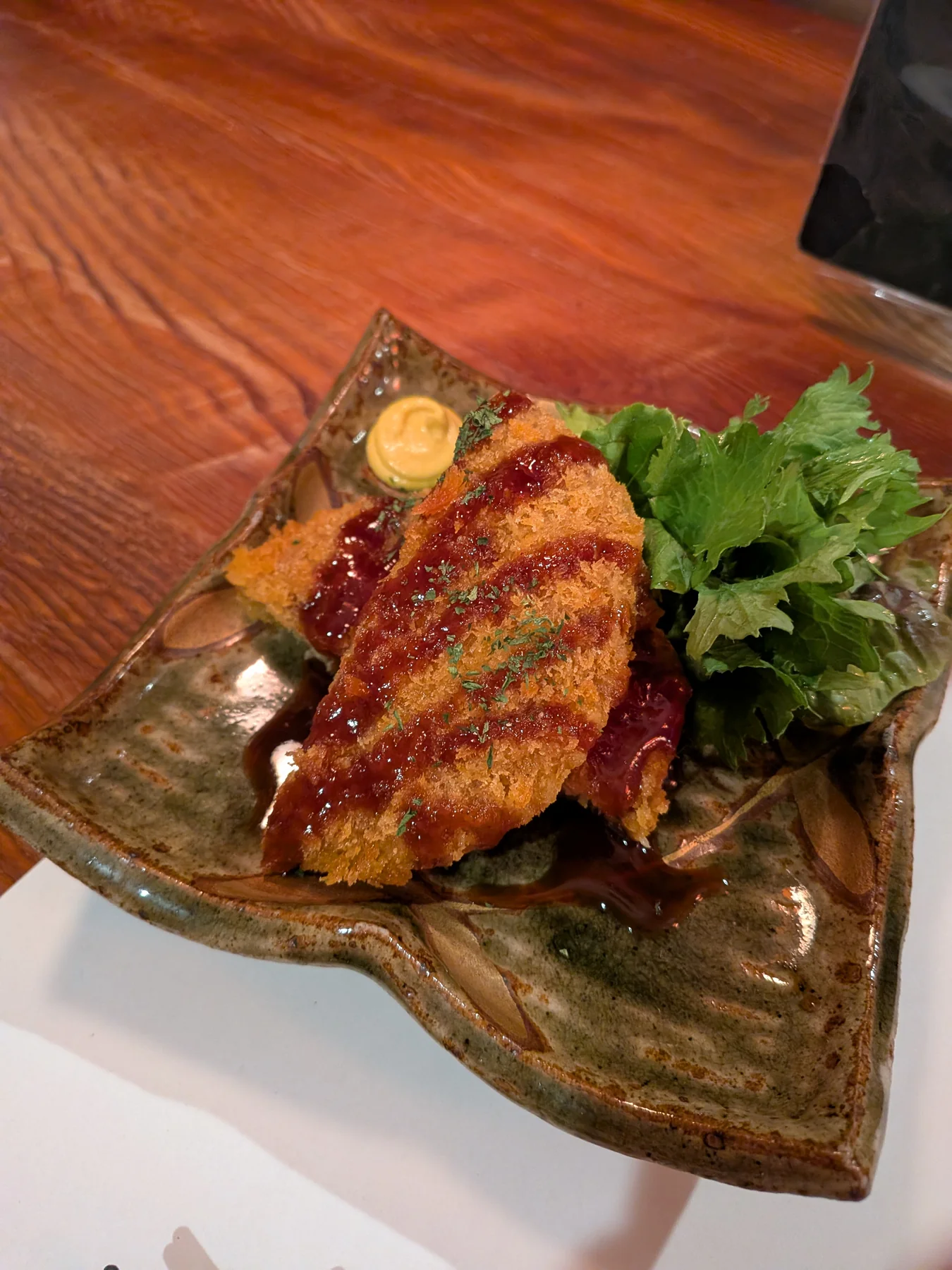
| Tonkatsu / menchi-katsu | Breaded meat, rendered fat, and optional sauce | Body for the meat; Acidity for fat; Finish for the close; Umami for meat and sauce | The filling and sauce often matter more than the crust alone. |
| Karaage / fried chicken | Fat plus salt, soy, garlic, ginger, or spice | Match Body to seasoning; use Acidity and Finish to reset; add Umami when soy leads | Fried chicken is not one fixed fruity, dry, or Junmai profile. |
| Rich sauce / glaze | Tonkatsu sauce, miso katsu, or sweet-savory glaze | Body for sauce intensity; Umami for savory depth; Acidity for fat or sweetness; Finish for a clean or sustained close | Decide whether you want to clear the sauce or deliberately carry it farther. |
If soy, miso, mushrooms, meat, or cheese is the dominant question, use the umami-rich sake guide. For fried or mayonnaise-based rolls, start with the more specific sushi pairing guide.
Exact bottle examples
Four bottles to compare—not a ranking
Each example has a current producer-owned exact product page, a published brewery, a complete six-axis TasteScore, and visible provenance. Producer facts support identity and specifications; coordinates and editorial readings are separate. None is presented as currently in stock.
High-structure breaded-meat comparison
Tengumai "Yamahai" Junmai
Shata Shuzo · Junmai
Sake Coordinates coordinates
- sweetness
- 2
- aroma
- 3
- body
- 4
- acidity
- 4
- umami
- 4
- finish
- 4
Editorial interpretation
Body, Acidity, Umami, and Finish all sit at 4. That evenly structured shape gives breaded meat, rendered fat, and savory sauce more support than the moderate benchmark below. The producer confirms rich flavor and acidity, but does not supply the TasteScore itself.
Moderate-weight benchmark
Hakkaisan “Tokubetsu Honjozo”
Hakkaisan Brewery · Tokubetsu Honjozo
Sake Coordinates coordinates
- sweetness
- 3
- aroma
- 3
- body
- 3
- acidity
- 2
- umami
- 3
- finish
- 3
Editorial interpretation
Body, Umami, and Finish all sit at 3 while Acidity is 2. That centered shape is a comparison point for lightly seasoned karaage or breaded meat when the sake should stay present without becoming the heaviest element.
Low-acidity, high-Finish comparison
Ichinokura "Tokubetsu Junmai" Taru
Ichinokura · Tokubetsu Junmai
Sake Coordinates coordinates
- sweetness
- 2
- aroma
- 4
- body
- 3
- acidity
- 2
- umami
- 3
- finish
- 4
Editorial interpretation
Acidity is 2, but Finish is 4. The producer describes kire and a clean, decisive close, followed by cedar aroma in the aftertaste. It shows why acidity is not the only way to reset after batter or salt.
Rich meat-and-sauce comparison
Kikusui “Funaguchi” Kunkou Black
Kikusui · Futsushu
Producer-supported facts
Futsushu · Nama genshu · RPR 70% · ABV 19% · Sake-lees shochu
Producer exact source ↗Sake Coordinates coordinates
- sweetness
- 2
- aroma
- 4
- body
- 4
- acidity
- 3
- umami
- 4
- finish
- 4
Editorial interpretation
Body, Umami, and Finish sit at 4, with Acidity 3. That makes it a structural comparison for menchi-katsu, miso katsu, or a sweet-savory glaze—not proof of a tasted pairing. The human-reviewed badge is not a direct-tasting claim.
First-hand evidence
Kokoro with menchi-katsu at Hinataya
On June 3, 2026, at Hinataya in Ikebukuro, Kokoro Tamazakae 70 Junmai Nama Genshu was served chilled and tasted with menchi-katsu. The direct Field Note records Sweetness 2, Aroma 2, Body 3, Acidity 4, Umami 3, and Finish 4.
The visit note says the bottle's firm acidity cut through the fried richness. The full coordinate also matters: moderate Body stayed with the minced-meat filling, while Finish 4 describes a decisive close after fat and crust. This is one exact dish-and-bottle observation—not evidence for every fried food, and not tasting evidence for the four catalog bottles above.
Read the Hinataya field noteUse the label as context
Junmai, Honjozo, nama, genshu, and rice-polishing ratio describe production choices. SMV is an analytical measure, not a complete sensory verdict. Use the label-reading guide and sweet-versus-dry guide, then return to the exact bottle's coordinates.
Common shortcuts to reject
Fried food always needs dry sake.
Dryness alone does not tell you whether the bottle has enough Body or a useful Finish.
High acidity is always better.
Acidity is one tool. Too much can dominate delicate tempura, and a high-Finish bottle can reset without high Acidity.
Junmai is automatically best.
Junmai is a production category, not a guaranteed fried-food profile.
A crisp finish means a short aftertaste score.
Finish measures the contour and resolution of the aftertaste, including crispness, sharpness, kire, and, when relevant, persistence.
Tempura and tonkatsu need the same sake.
Batter is only one variable; filling, meat, sauce, and seasoning change the weight of the match.
A higher TasteScore means a better pairing.
TasteScore measures intensity by axis, not quality or rank.
What to try next
Compare one dish with two shapes
Pour two exact bottles with the same fried dish: keep Acidity similar and change Body or Finish, or hold Body steady and change Acidity. Record which bottle clears the palate and which carries the food farther. Compare candidates on the Taste Map; if you need a first-bottle starting point, use the palate-first beginner guide.
Frequently asked questions
What sake goes with fried food?+
Start with Acidity, then match Body and Finish to the weight of the batter, filling, and sauce. Use Umami when meat, soy, miso, or a savory glaze leads. The exact balance matters more than one category label.
What sake goes with tempura?+
For delicate tempura, start with restrained Body and Aroma, moderate Acidity, and a clean or crisp Finish. The goal is to refresh the palate without covering vegetables, shrimp, or white fish.
What sake goes with tonkatsu or menchi-katsu?+
Use enough Body for the meat, Acidity for fat, and Finish for how the sake clears the crust and sauce. Add Umami when the filling or sauce is strongly savory.
What sake goes with karaage or fried chicken?+
Match the seasoning first. Salt, soy, garlic, ginger, and spice change the target. Body should keep up, while Acidity and Finish determine how the palate resets.
Is dry sake best with fried food?+
Not automatically. Perceived dryness is only one part of the profile. A dry sake may still be too light for rich meat or may lack the Finish you want after a heavy sauce.
Does acidity help with fried food?+
Yes. Acidity can add lift through fat and sweetness, but it is not the only useful axis. Body matches weight, Finish shapes the close, and Umami connects savory ingredients.
Does Junmai pair well with fried food?+
It can, but Junmai does not guarantee a particular Body, Acidity, Umami, or Finish. Check the exact bottle rather than choosing by category alone.
Is sparkling sake good with fried food?+
It can be a useful contrast when bubbles, acidity, light Body, and a decisive Finish suit the dish. Sweetness and Aroma still matter, especially with delicate tempura or sweet glazes.
Should sake with fried food be served cold?+
Cold service is a practical starting point for crisp or sparkling profiles, but it is not a rule. The bottle's producer guidance and the dish's weight matter more than a universal temperature.
How does Sake Coordinates choose bottle examples?+
We require a published exact bottle and brewery, a current producer-owned exact product source, a complete six-axis TasteScore, visible provenance, and no material identity, specification, or Finish-semantic conflict. Direct tasting is labeled separately.
Sources and boundaries
Primary evidence used
General sources support general pairing principles. Producer pages support only exact product identity and visible specifications. TasteScore provenance is shown on each card, and direct tasting is confined to the Hinataya section.
- 01NRIB — Sake and Food Pairings — Flavor-intensity matching and contrast as pairing approaches
- 02JSS — Basic Sake and Food Pairings — Palate refreshment, intensity matching, aroma, and contrast
- 03JSS — The Sake Manual — Body, sauce, acidity, bitterness, and fried-food context
- 04Official producer source — tengumai-yamahai-junmai — Current exact-product identity and visible specifications only
- 05Official producer source — hakkaisan-tokubetsu-honjozo — Current exact-product identity and visible specifications only
- 06Official producer source — ichinokura-tokubetsu-junmai-taru — Current exact-product identity and visible specifications only
- 07Official producer source — kikusui-funaguchi-kunko — Current exact-product identity and visible specifications only