Savory pairing guide
Umami-Rich Sake: How to Choose It for Miso, Mushrooms, Meat, and Cheese
Umami-rich sake can work beautifully with miso, mushrooms, meat, and cheese—but Umami alone does not make the match. Compare it with Body, Acidity, and Finish, then check the exact bottle. Junmai, kimoto, and yamahai are clues, never guarantees.
Direct answer
Look beyond one savory score
Choose higher Umami when you want a savory bridge. Add Body for concentrated food, Acidity for lift through fat or dense seasoning, and Finish for how decisively the sake clears the dish's aftertaste—or, when useful, carries it farther. Start with the food, then compare exact bottles on the Taste Map.
What umami means in sake
Umami is one of the five basic tastes. In sake, amino acids and peptides contribute to the savory impression. That does not make one compound or one lab value a complete sensory answer.
Body describes weight and texture. Finish describes the contour and resolution of the aftertaste—its sharpness, crispness, clean cut, and, when relevant, persistence. A bottle may be savory but centered, or full-bodied without resolving the same way. The six-axis model keeps those differences visible. See what sake tastes like and how TasteScore is built.
Recognize the profile
Use Umami as a starting coordinate
Begin with a bottle's published Umami score, then read the other five dimensions. There is no universal cutoff that turns a sake into an “umami sake,” and a higher number is not a better rating.
Two bottles can both sit at Umami 4 while differing in Body, Acidity, Aroma, or Finish. Those differences explain more at the table than category prestige or rice polishing ratio alone.
Food-first decisions
Miso, mushrooms, meat, and cheese need different balances
| Food | Split the dish | Read these axes | Avoid the shortcut |
|---|---|---|---|
| Miso | Light miso soup vs. concentrated glaze | More Body for concentration; enough Acidity and a clear Finish to reset after a dense glaze | Do not assume every Junmai will match every miso dish. |
| Mushrooms | Delicate sauté vs. roasted or dried mushrooms | Umami first; match Body to intensity and Finish to a clean or sustained close | Earthy aroma is optional; savory structure matters more. |
| Meat | Lean grilled meat vs. fatty, braised, or glazed meat | Body for intensity; Acidity for fat; Finish for how decisively the sake clears fat and seasoning | High Umami alone may feel broad beside rich fat. |
| Cheese | Fresh and mild vs. aged and hard cheese | Match Body to intensity; use Finish for a clean cut or a more sustained aftertaste | Aged cheese does not require the heaviest sake available. |
For fish and rice decisions, use the more specific sake-for-sushi guide. When batter, frying fat, or katsu sauce changes the question, use the fried-food pairing guide.
Exact bottle examples
Four published coordinates—not a ranking
Every example has a current official product source, a complete six-axis profile, and visible provenance. Producer facts, Sake Coordinates interpretation, and direct tasting are kept separate.
Structured savory reference
Tengumai "Yamahai" Junmai
Shata Shuzo · Junmai
- sweetness
- 2
- aroma
- 3
- body
- 4
- acidity
- 4
- umami
- 4
- finish
- 4
Coordinate reading
Umami, Body, Acidity, and Finish all sit at 4. That balanced structure makes this a useful reference for savory dishes without turning Yamahai into a flavor guarantee.
Cedar-led clean-finish comparison
Ichinokura "Tokubetsu Junmai" Taru
Ichinokura · Tokubetsu Junmai
- sweetness
- 2
- aroma
- 4
- body
- 3
- acidity
- 2
- umami
- 3
- finish
- 4
Coordinate reading
Aroma and Finish sit at 4, while Body and Umami are 3 and Acidity is 2. The producer describes a clean, decisive close (kire), which aligns with the higher Finish score; the cedar aroma also carries into the aftertaste.
Concentrated nama genshu reference
Kikusui “Funaguchi” Kunkou Black
Kikusui · Futsushu
- sweetness
- 2
- aroma
- 4
- body
- 4
- acidity
- 3
- umami
- 4
- finish
- 4
Official product facts
Futsushu · Nama genshu · RPR 70% · ABV 19% · Sake-lees shochu
Producer source ↗Coordinate reading
Body, Umami, and Finish sit at 4. Its concentration is bottle-specific; the human-reviewed badge does not mean Sake Coordinates directly tasted it.
Brighter savory ginjo reference
Narutotai “Ginjo” Nama Genshu
Narutotai · Ginjo
- sweetness
- 2
- aroma
- 3
- body
- 4
- acidity
- 2
- umami
- 4
- finish
- 4
Official product facts
Ginjo · Nama genshu · Current producer page: ABV 18.5% · Aluminum container
Producer source ↗Coordinate reading
Umami and Finish sit at 4, but Acidity is 2 and Body 4. It is a reminder that the same umami score can arrive with a different structural balance.
First-hand evidence
What we actually tasted with food
These restaurant observations support pairing reasoning. They do not validate the four catalog examples above unless the exact bottle is the one named in the note.
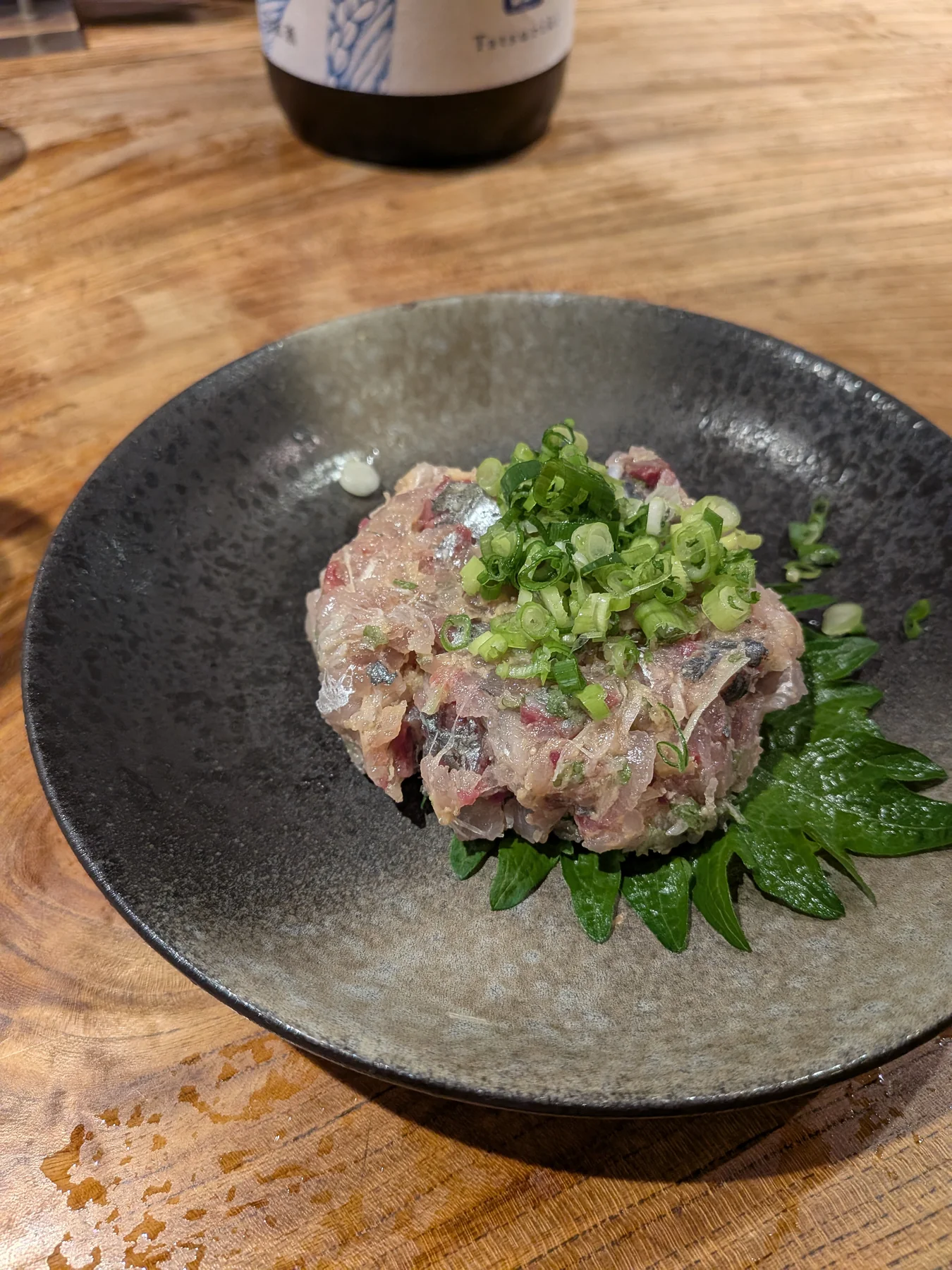
Tatsuriki Shinryu Nishiki Nama with namerou
At Ura-ya, rice-driven umami met fish and miso, while the finish stayed clean. This was a direct, dish-specific observation—not evidence that all kimoto works with namerou.
Read the field noteUekiya Special-Order Sakasa Yaemon Nama with aged beef tongue
At Nose to Tail, the sake's acidity cut through the fat and the finish stayed clean beside aged beef tongue. The exact bottle and dish were tasted together.
Read the field noteIzumibashi Kuro Tombo with ayu confit
At Enrai, heating seemed to bring body, acidity, and umami into clearer focus against sweetfish bitterness. The liquid temperature was not measured.
Read the field noteUse labels as context
Junmai tells you no brewer's alcohol was added. Kimoto and yamahai describe starter methods. Nama and genshu describe pasteurization and dilution choices. These facts narrow the context; none replaces bottle-level evidence. Use the label-reading guide and the kimoto vs. yamahai guide.
Common shortcuts to reject
Umami-rich means heavy.
Umami is savoriness. Body is weight and texture. Read them separately.
Umami-rich means sweet.
Sweetness is another axis. All four examples here sit at Sweetness 2.
Junmai guarantees umami.
Junmai is a production category, not a bottle-level sensory promise.
Kimoto or Yamahai guarantees a savory match.
Starter method is context. The exact bottle's full coordinate still decides.
Amino acid value equals perceived umami.
It is an analytical index; sensory perception depends on the broader composition.
A higher Umami score means higher quality.
TasteScore describes intensity, not quality, prestige, or value.
What to try next
Move from the dish to two exact bottles
Choose two bottles with similar Umami but different Body or Acidity, then compare them with the same food. If you are still finding your starting direction, return to the palate-first beginner guide. If sweetness is the question, use the sweet-versus-dry guide.
Frequently asked questions
What is umami in sake?+
Umami is the savory basic taste associated with amino acids and peptides in sake. It is one part of the palate, alongside sweetness, acidity, aroma, body, and finish.
Is umami-rich sake always full-bodied?+
No. Umami and Body are separate dimensions. A sake can be savory with moderate body, or full-bodied without being especially umami-forward.
Is Junmai sake more umami-rich?+
Junmai can be a useful clue in some bottles, but the category does not guarantee a high-umami profile. Check the exact bottle's data and sensory evidence.
Are kimoto and yamahai always savory?+
No. These starter methods can support body and complexity, but rice, koji, yeast, fermentation, aging, dilution, storage, and serving all affect the finished sake.
What sake goes with mushrooms?+
Start with enough Umami for the dish, then match Body to the mushrooms' intensity. Use Finish to choose whether the sake should resolve cleanly or carry the roasted or dried flavors farther.
What sake goes with miso?+
Match the concentration of the miso dish. A light soup may suit moderate Body, while a dense glaze can take more Body. Acidity and a clearly resolving Finish can keep the pairing from feeling broad.
What sake goes with meat?+
Use Body for the meat and sauce intensity, Acidity for fat, and Finish for how decisively the sake clears fat and seasoning—or how deliberately the aftertaste continues. Umami alone is not enough.
Does sake pair with cheese?+
Yes. Sake can support cheese's savory aftertaste. Match Body to the cheese, then use Finish to choose a clean cut or a more sustained close. Consider Acidity when the cheese is rich.
Does amino acid value tell me how savory sake tastes?+
Not by itself. It is a useful analytical index, but the perceived result depends on the balance of amino acids, peptides, acids, sugars, alcohol, aroma, and serving conditions.
How does Sake Coordinates choose umami-rich examples?+
We require a published exact bottle, a complete six-axis TasteScore, visible provenance, a published brewery, and an official current product source. Direct tasting notes are shown separately from research-based profiles.
Sources and boundaries
Primary evidence used
General sources support general claims. Producer pages support only the exact product facts visible there. Category averages are not used to prove an individual bottle's taste.
- 01NRIB — Sake and Food Pairings — Five basic tastes, cheese pairing, and bottle-specific serving context
- 02JSS — What Does Sake Taste Like? — Umami compounds and the separation of taste, body, and finish
- 03National Tax Agency — Components of Sake — Amino acid value as an analytical index and category-level averages
- 04NRIB — Sake and Cheese Research — Controlled evidence on sake, cheese, organic acids, and aftertaste
- 05NRIB — A Comprehensive Guide to Japanese Sake — Umami, body, finish, and limits of single-compound explanations
- 06Official producer source — tengumai-yamahai-junmai — Current exact-product identity and visible specifications only
- 07Official producer source — ichinokura-tokubetsu-junmai-taru — Current exact-product identity and visible specifications only
- 08Official producer source — kikusui-funaguchi-kunko — Current exact-product identity and visible specifications only
- 09Official producer source — narutotai-ginjo-nama-genshu — Current exact-product identity and visible specifications only
- 10Kikusui official Japanese specification — kikusui-funaguchi-kunko — Current exact-product identity, futsushu and nama genshu classification, RPR 70%, ABV 19%, and sake-lees shochu ingredient