Food-first pairing guide
Best Sake for Steak and Grilled Meat: Match Fat, Char, Umami, and Finish
Steak is not one pairing target. A salted sirloin, fatty Wagyu, charcoal-grilled chicken, tare-coated yakiniku, and aged beef each ask different questions. Start with the plate's structure, then compare exact bottles instead of choosing by “rich,” Junmai, Yamahai, or dry alone.
Direct answer
Match the meat, cooking, and seasoning
For steak and grilled meat, match Body to the weight of the meat and sauce, use Acidity to refresh fat, and use Umami to connect savory seasoning. Finish tells you how clearly and decisively the sake resolves fat, char, salt, and sauce. Aroma and Sweetness become supporting axes when smoke, garlic, spice, or glaze changes the plate.
Why meat is not one pairing target
Cut and fat change weight. Searing and charcoal add aromatic, roasted, bitter intensity. Salt leaves a different aftertaste from tare, miso glaze, garlic, or sweet sauce. Aging can concentrate savory impressions, but it does not turn aged sake into an automatic match.
Body asks whether the sake can stay present. Acidity can refresh, but it is not the only answer. Umami can connect meat, soy, or miso without becoming a quality rank. Finish covers aftertaste contour and resolution—including sharpness, crispness, clean cut, kire, and persistence when relevant. Learn the six-axis model in what sake tastes like, and compare savory shapes in the umami-rich sake guide.
Meat decision matrix
Lean, fat, char, sauce, and aging change the target
| Dish | Split the dish | Read these axes | Watch for |
|---|---|---|---|
| Lean steak / salted beef | Lean cut, modest fat, salt-led seasoning | Moderate Body, needed Acidity, restrained Aroma, decisive Finish | Excess Body can cover a simple sirloin or beef tongue. |
| Fatty beef / Wagyu | Ribeye, Wagyu, or fatty yakiniku cuts | Body to stay present; Acidity to refresh; Finish to resolve fat; optional Umami | Highest Acidity is not automatically best, and Umami is not Body. |
| Grilled / charred meat | Sear, charcoal, roasted bitterness, seasoning | Body and Finish; Aroma for competition or contrast; Umami and Sweetness when seasoning calls | Char is not Umami, and smoke is not a Body score. |
| Sauce-heavy meat | Tare, teriyaki, miso glaze, garlic, sweet-savory sauce | Body for intensity; Umami for savory layers; Acidity for fat or sweetness; Finish for the close | Read the sauce as carefully as the cut. |
| Aged beef | Concentrated savory character plus the cut's fat and seasoning | Body, Umami, Acidity, and Finish in relation to the actual plate | Aged beef does not require aged sake; the aging processes differ. |
For crisp coatings and fried chicken, use the fried-food decision framework. If you are choosing from an izakaya list, the izakaya ordering guide helps turn this structure into a practical question.
Exact bottle examples
Four bottle shapes to compare—not a ranking
Each example has a current producer-owned exact product page, a published brewery, a complete six-axis TasteScore, and visible provenance. Producer facts support identity, specifications, and explicitly labeled guidance; coordinates and editorial readings are separate. None is presented as currently in stock or directly tasted with meat.
Lean-meat fruit-and-finish comparison
Shichiken “Kinunoaji”
Shichiken · Junmai Daiginjo
Producer-supported facts
Junmai Daiginjo · ABV 15% · Pronounced strawberry, banana, and yogurt notes · Soft, savory palate · Long finish
Producer guidance: The producer recommends pan-fried chicken and describes the aroma as restrained relative to the style, not aroma-free.
Producer exact source ↗Sake Coordinates coordinates
- sweetness
- 3
- aroma
- 4
- body
- 3
- acidity
- 2
- umami
- 3
- finish
- 4
Editorial interpretation
Body 3 and Acidity 2 keep this below the highest-structure examples, while Aroma and Finish sit at 4. That makes it a useful fruit-and-finish comparison for simply seasoned lean meat: the producer's pronounced fruit notes support Aroma 4 even though the aroma is restrained relative to this style, and its long finish supports Finish 4. The pairing remains an editorial test rather than a producer ranking.
Fatty beef and high-structure comparison
Tengumai "Yamahai" Junmai
Shata Shuzo · Junmai
Producer-supported facts
Junmai · Yamahai · RPR 60%
Producer guidance: The producer lists meat and Western dishes among its recommended dishes.
Producer exact source ↗Sake Coordinates coordinates
- sweetness
- 2
- aroma
- 3
- body
- 4
- acidity
- 4
- umami
- 4
- finish
- 4
Editorial interpretation
Body, Acidity, Umami, and Finish all sit at 4. That even, high-structure shape gives fatty beef or a savory grilled plate several points of contact. The producer's meat guidance is supportive context—not an objective ranking and not proof that every steak needs Yamahai.
Char-and-aroma comparison
Ichinokura "Tokubetsu Junmai" Taru
Ichinokura · Tokubetsu Junmai
Sake Coordinates coordinates
- sweetness
- 2
- aroma
- 4
- body
- 3
- acidity
- 2
- umami
- 3
- finish
- 4
Editorial interpretation
Aroma 4 and Finish 4 make this a deliberate comparison for grilled or charred meat, but cedar aroma is not treated as smoke and char is not converted into a TasteScore. The producer describes kire and a clean close, which is directionally consistent with Finish 4; Acidity remains 2.
Rich sauce and full-flavor comparison
Kikusui “Funaguchi” Kunkou Black
Kikusui · Futsushu
Producer-supported facts
Futsushu · Nama genshu · RPR 70% · ABV 19% · Sake-lees shochu
Producer exact source ↗Sake Coordinates coordinates
- sweetness
- 2
- aroma
- 4
- body
- 4
- acidity
- 3
- umami
- 4
- finish
- 4
Editorial interpretation
Body, Umami, and Finish sit at 4, with Acidity 3. That shape creates a useful test against tare, miso glaze, or another intense sweet-savory sauce. It is not a directly tasted meat pairing, and the human-reviewed badge does not claim that it is.
What we actually tasted
Two first-hand meat comparisons
Aged beef tongue at Nose to Tail
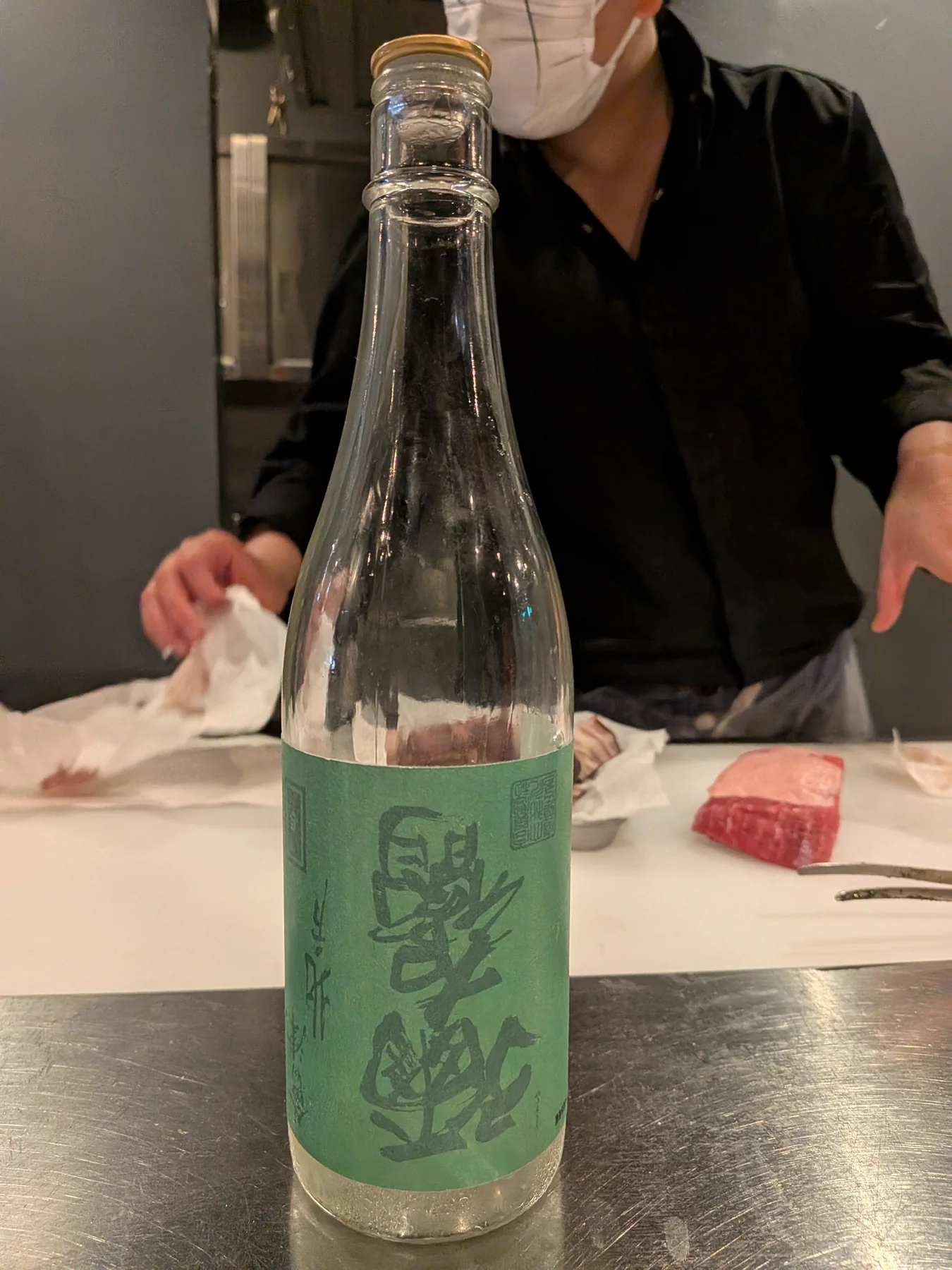
On June 20, 2026, Uekiya Exclusive Yamayo Mark Upside-Down Yauemon Nama was served chilled, with a wine glass recommended, and tasted with aged beef tongue in Kagurazaka. The Field Note records Sweetness 4, Aroma 2, Body 3, Acidity 5, Umami 3, and Finish 4.
The published note records acidity arriving first, keeping sweetness from feeling heavy, cutting through the tongue's fat without stripping its flavor, and closing cleanly. This supports one exact dish-and-bottle observation—not every aged beef pairing and not the catalog bottles above.
Read the Nose to Tail field noteWasabi-grilled chicken at Miyashita Naru
On June 14, 2026, Yuho “Yuho no Midori” Kimoto Junmai Nama was served chilled and tasted with wasabi-grilled chicken neck in Shibuya. Its direct Field Note records 3 / 2 / 4 / 4 / 3 / 3 across Sweetness, Aroma, Body, Acidity, Umami, and Finish.
The published note records bright acidity, body, and rice-driven umami holding with soy and wasabi, with acidity cutting through rather than getting lost. It does not establish a universal grilled-chicken rule or catalog eligibility.
Read the Miyashita Naru field noteUse labels as context, not destiny
Junmai, Honjozo, kimoto, Yamahai, nama, and rice-polishing ratio describe production choices. They do not guarantee meat pairing, Umami, or Body. Compare kimoto and Yamahai without turning either into a richness shortcut, and use the sweet-versus-dry guide before treating SMV as taste.
Common shortcuts to reject
Steak always needs a full-bodied sake.
Lean meat and simple salt may be covered by unnecessary weight.
Wagyu always needs the highest acidity.
Acidity refreshes fat, but Body and Finish determine presence and resolution.
Junmai is automatically best with meat.
Junmai is a production category, not a guaranteed coordinate shape.
Aged beef should be paired with aged sake.
Meat aging and sake maturation are separate; choose by resulting profiles.
Char means you need smoky or aged sake.
Char is a food-side roasted intensity, not a direct TasteScore conversion.
A higher Umami score means a better meat pairing.
Umami measures one axis, not quality or pairing rank.
A crisp Finish means a low Finish score.
Crispness, sharpness, clean cut, and kire are high-Finish signals.
SMV tells you whether a sake works with steak.
SMV is an analytical value, not the complete sensory profile.
What to try next
Compare one meat dish with two shapes
Pour two exact bottles beside the same steak or grilled dish. Keep Body similar and change Acidity or Finish, or hold Acidity steady and change Body. Record which stays present, which refreshes, and how each resolves the final bite. Compare candidates on the Taste Map; if you need a starting point, use the palate-first beginner guide.
Frequently asked questions
What sake goes with steak?+
Match Body to the cut and sauce, use Acidity to refresh fat, Umami to connect savory seasoning, and Finish to decide how clearly the sake resolves salt, char, and fat. There is no single category for every steak.
What sake goes with Wagyu?+
For rich Wagyu, compare bottles with enough Body to remain present, useful Acidity, and a decisive Finish. The highest Acidity is not automatically best, and Umami is not Body or quality.
What sake goes with grilled beef?+
Read the cut, char, salt, and sauce separately. Body handles weight, Finish shapes the close, and Aroma can compete with or complement grilled notes. Char itself is not Umami.
What sake goes with yakiniku?+
Start with the specific cut and seasoning. Salted lean cuts may need restraint, while fatty cuts or tare can call for more Body, Acidity, Umami, and Finish.
What sake goes with beef tongue?+
For simply salted beef tongue, try moderate Body, restrained Aroma, useful Acidity, and a clean, decisive Finish. A richer preparation may need a different balance.
Does Junmai pair well with steak?+
It can, but Junmai does not guarantee Body, Acidity, Umami, or Finish. Compare the exact bottle rather than relying on the category.
Is dry sake best with steak?+
Not automatically. Perceived dryness does not tell you whether a bottle can match fat, sauce, or char. SMV alone is not a pairing decision.
Does acidity help with fatty beef?+
Yes, Acidity can refresh through fat, but Body determines whether the sake stays present and Finish determines how the aftertaste resolves.
Does aged sake go with aged beef?+
It can, but not simply because both are aged. Evaluate the meat against the matured sake's actual Body, Aroma, Acidity, Umami, Sweetness, and Finish.
What sake goes with grilled chicken?+
Match the cut and seasoning. Lean breast, fatty skin, yakitori salt, tare, garlic, and spice create different targets for Body, Acidity, Umami, and Finish.
Should sake with steak be served cold or warm?+
There is no universal steak rule. Follow producer guidance or a documented first-hand serving condition, then compare how temperature changes the exact bottle beside the dish.
How does Sake Coordinates choose meat-pairing bottles?+
We require a published exact bottle and brewery, a current producer-owned exact-product source, a complete six-axis TasteScore, visible provenance, and no material identity, specification, or six-axis semantic conflict. Direct tasting is labeled separately.
Sources and boundaries
Primary evidence used
General sources support general pairing principles. Producer pages support only exact product identity, visible specifications, and explicitly labeled producer guidance. TasteScore provenance appears on each card, and direct tasting is confined to the two first-hand comparisons.
- 01NRIB — Sake and Food Pairings — Intensity matching, contrast, and general pairing principles
- 02JSS — Basic Sake and Food Pairings — Flavor intensity, palate refreshment, aroma, and contrast
- 03JSS — The Sake Manual — Body, acidity, umami, sauce, meat, and serving context
- 04Official producer specification source — shichiken-kinunoaji — Exact-product identity and visible specifications only
- 05Official producer specification source — tengumai-yamahai-junmai — Exact-product identity and visible specifications only
- 06Official producer specification source — ichinokura-tokubetsu-junmai-taru — Exact-product identity and visible specifications only
- 07Official producer specification source — kikusui-funaguchi-kunko — Exact-product identity and visible specifications only