Time changes sake—but not by one formula
What Is Aged Sake (Koshu)? How Time Changes Sake
Aged sake is sake intentionally matured beyond its normal young-release period. You may see koshu or jukuseishu on a label, but there is no single age threshold or automatic flavor profile for every use of those words. Time matters together with the original sake, storage temperature, light, oxygen, duration, and producer intent.
Direct answer
What is aged sake?
It is sake matured intentionally beyond the period in which the producer would normally release it as a young sake. Aging can shift color, aroma character, texture, and flavor balance. It does not automatically make sake darker, sweeter, richer, more savory, longer-finishing, better, or more valuable.
Words with overlapping uses
Aged sake, koshu, jukuseishu, and long-aged sake
These terms overlap, but sources do not give them one universal boundary. The safest beginner definition is conceptual first, then source-specific on timing.
| Term | Useful reading | Boundary to keep |
|---|---|---|
| Aged sake | A practical English umbrella term for sake intentionally matured beyond its normal young-release period | Not one legal age threshold or one flavor profile |
| Koshu | Often translated as old or aged sake; JSS sources use both brewing-season and elapsed-time conventions | Context matters: one JSS label guide says usually over one year, while its English glossary uses more than two years |
| Jukuseishu | Matured sake; JSS's English glossary applies its professional-aging definition here | The word does not establish the exact storage history on its own |
| Long-aged sake | A narrower phrase for extended maturation | NRIB discusses properly stored 10–20-year sake; the Reserve Sake Association separately defines its certified category as at least three full years at the brewery |
No universal clock
How old is aged sake?
Official and industry sources answer differently because they are defining different contexts. None of the rows below should be rewritten as the single legal threshold for all aged sake in Japan.
| Source | Time convention | How to use it |
|---|---|---|
| JSS English glossary | More than two years after brewing | A consumer glossary definition for professionally aged sake / koshu / jukuseishu |
| JSS label guide | Usually over one year and aged on purpose | A label-reading convention, not a universal legal floor |
| JSS Japanese glossary | Generally from a prior brewing season or brewing year | Koshu as the counterpart to shinshu in a brewing-season context |
| Reserve Sake Association | At least three full years matured at the brewery | That association's definition for its long-aged category, not a threshold for every aged sake |
Possibilities, not conversions
What aging can change through the TasteScore framework
JSS describes Maillard-related changes involving sugars and amino-acid components, with possible amber color, less fruity and more toasted character, nutty or dried-fruit notes, and smoother texture. Storage conditions change the trajectory. TasteScore helps you observe the result; it does not calculate the result from age.
Sweetness
- Observe
- Perceived sweetness, not age or SMV alone
- Possible change
- Mature aromas and texture can change how sweetness appears
- Not guaranteed
- Sweetness does not have to rise
Aroma
- Observe
- Intensity separately from character
- Possible change
- Fruit or floral character may recede while nutty, caramel-like, spicy, roasted, or dried-fruit character may emerge
- Not guaranteed
- Aroma need not become stronger, and no note is mandatory
Body
- Observe
- Flavor fullness
- Possible change
- The sake may feel fuller or more integrated depending on the base sake and maturation
- Not guaranteed
- Age is not a Body-score formula
Texture
- Observe
- Smoothness, silkiness, or viscosity
- Possible change
- JSS and NRIB describe smoother matured examples
- Not guaranteed
- Texture is not the same as Body
Acidity
- Observe
- Intensity and whether it feels sharp, round, or integrated
- Possible change
- Its relationship to sweetness, aroma, and texture may shift
- Not guaranteed
- Age does not set one Acidity score
Umami
- Observe
- The savory impression
- Possible change
- Maturation can alter compounds and the balance in which savoriness is perceived
- Not guaranteed
- Age does not guarantee high Umami or quality
Finish
- Observe
- Length plus crispness, clean cut, convergence, bitterness, and alcohol heat where relevant
- Possible change
- Some aged examples become longer or smoother
- Not guaranteed
- Aged sake can still have a short or low-scoring Finish
For the underlying axis definitions, read What Does Sake Taste Like?. Finish is not length alone: crispness, sharpness, clean resolution, and kire can also support a higher Finish reading.
Time alone is not the process
Why storage matters—and why intentional aging is not deterioration
Managed maturation
A producer can choose the base sake and manage time, temperature, light, oxygen exposure, and storage format toward a matured style. Low-temperature storage can preserve a lighter direction while warmer conditions may accelerate color and aroma change. Those paths should not be treated as interchangeable.
Damage and off-flavor
NRIB identifies high temperature, light, and oxygen as quality-damage factors. It also distinguishes mature aroma from hine-ka, an off-flavor associated with poor extended preservation. An old bottle of unknown history is not automatically intentional aged sake.
A brewing-year label, not a stopwatch
What does 2007BY mean?
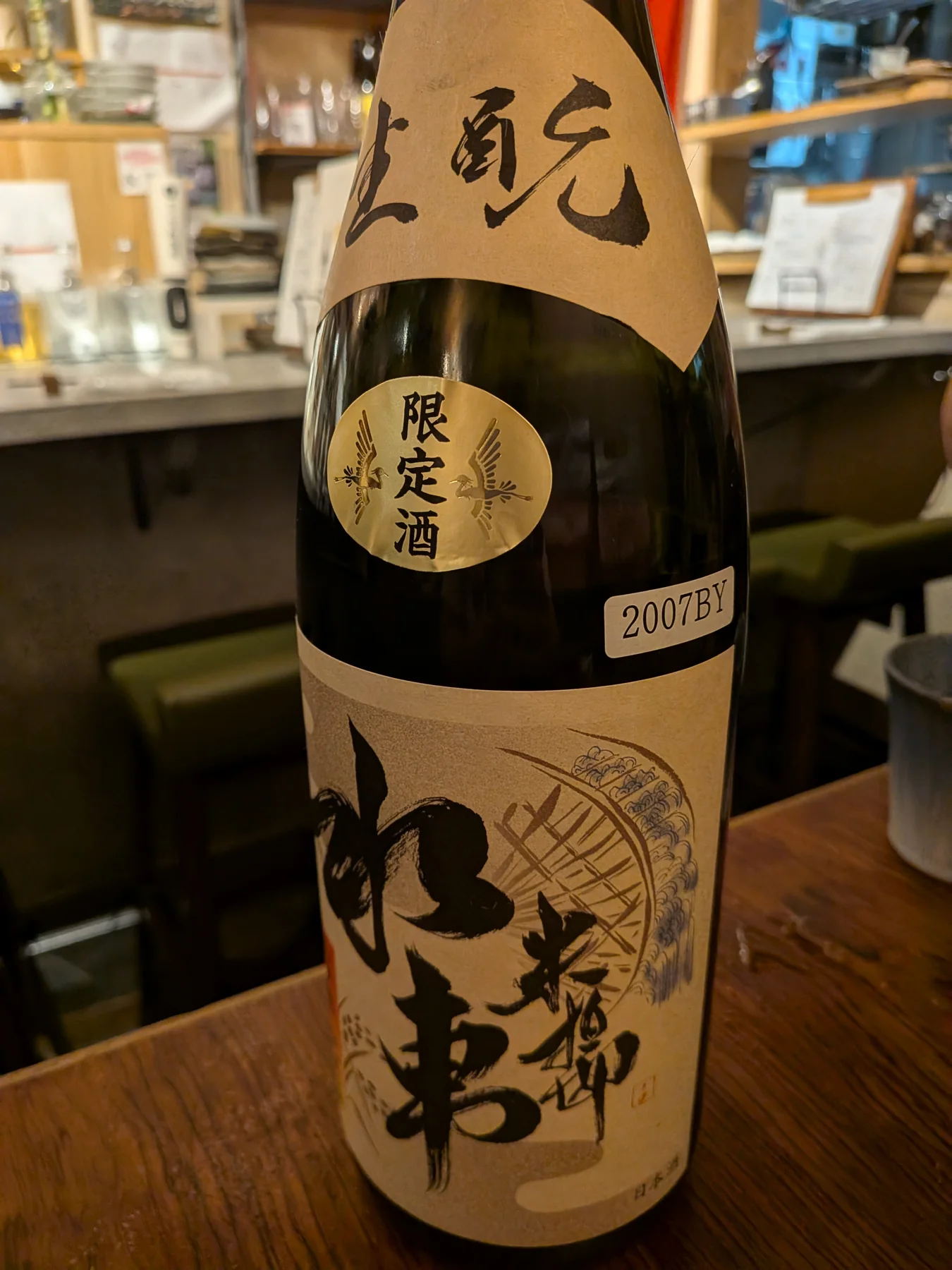
BY means Brewing Year, corresponding to the Japanese sake brewing year. JSS defines it as July 1 through June 30. Therefore, 2007BY identifies a brewing-year period; it is not simply “calendar-year 2007 vintage.”
BY does not tell you the exact pressing date, bottling date, storage start, storage vessel, temperature history, or exact time under one condition. For the bottle below, we use “a 2007 brewing-year sake.” We do not convert the label into a claimed 18-year or 19-year maturation period.
The sake label guide explains how date information fits beside category, rice polishing ratio, ABV, and storage instructions.
Bottle-specific first-hand evidence
Kometsuki Suisha 2007BY at Karasu
On June 17, 2026, at Sake and Bistro Karasu in Monzen-nakacho, we tasted Kometsuki Suisha Kimoto Junmai Yamadanishiki 2007BY chilled with mussels and clams steamed in white wine. The source note and published Journal directly record a deeply aged kimoto, rice-driven umami, firm acidity, savory structure, and the night's best match.
User-tasted TasteScore
- sweetness
- 2
- aroma
- 3
- body
- 5
- acidity
- 3
- umami
- 4
- finish
- 2
source_status: user_tasting · confidence: high · actual serving: chilled / reishu
Why the shape matters: Body 5 and Umami 4 coexist with Finish 2. The bottle felt powerful and savory without receiving a high Finish score. This is exactly why “rich” should not make every coordinate high.
Evidence limit: this is one bottle, one dish, and one visit. We do not infer its exact aging duration, storage temperature, vessel, oxidation level, producer intent, or current availability. We also do not generalize the pairing into “aged sake goes with shellfish.”
Read the Karasu Journal notePair by the resulting profile
What food goes with aged sake?
JSS gives three useful starting points: match the intensity of sake and food, match aroma families, and try aged sake with pickles, dried fruit, or aged cheese. A sake with roasted character may also be tested beside a stewed or grilled dish. These are comparison ideas, not category guarantees.
For the Karasu bottle, the documented match was mussels and clams steamed in white wine. Its rice-driven umami, firm acidity, and savory structure ran alongside the broth and shellfish umami. That direct observation belongs only to this bottle and plate.
If you want to compare savory profiles, use the umami-rich sake guide without treating Umami as quality. For a richer meat context, the steak pairing guide separates fat, char, sauce, and Finish.
A small beginner workflow
How to try aged sake
- Read the producer's exact age, storage, and serving statement. Do not age an ordinary bottle by assumption.
- Start with a small pour at the producer's recommended temperature.
- Separate Aroma intensity from character, and Body from Texture.
- Record Sweetness, Aroma, Body, Acidity, Umami, and Finish independently.
- Try one food that matches intensity or aroma, then change only one variable.
- If the producer supports another serving range, compare a second small pour rather than assuming warm or chilled is best.
Catalog audit result
Why there is no forced bottle list here
We audited every published catalog candidate with an aging field, aged process tag, vintage or brewing-year field, or aged / jukusei / koshu wording. No bottle cleared every current gate at once: published bottle and brewery, exact current producer source, confirmed maturation status, complete six-axis TasteScore, provenance, and no material identity, specification, Aroma, or Finish conflict. The catalog example set is therefore currently limited by provenance and data-audit gates. We did not lower the standard or change production data to fill this section.
You can still compare the site's published research profiles on the Taste Map and read how TasteScore provenance is labeled.
Shortcuts to reject
Common aged-sake myths
Aged sake means at least three years.
Three years is a named association's category definition. Other JSS sources use different conventions.
An old forgotten bottle is aged sake.
Intentional, managed maturation is different from deterioration caused by heat, light, oxygen, or poor storage.
All aged sake is dark, sweet, nutty, and rich.
Those are possible developments, not requirements. Low-temperature and warmer maturation can follow different paths.
Older means better, higher quality, or automatically more expensive.
Age records time. It does not rank quality, enjoyment, or price.
Aged sake must have high Body, Umami, and Finish.
The six axes remain independent. Our 2007BY Field Note is Body 5, Umami 4, and Finish 2.
Aged sake is the same as kijoshu, kimoto, Yamahai, Junmai, or Daiginjo.
Those terms describe other production axes. They can overlap with aging without becoming synonyms.
Hiyaoroshi or aki-agari means long-aged sake.
These seasonal terms concern sake matured across the summer; they do not by themselves mean long aging.
Frequently asked questions
What is aged sake?+
Aged sake is sake intentionally matured beyond its normal young-release period. Time can change color, aroma character, texture, and flavor balance, but the result depends on the base sake, duration, temperature, light exposure, oxygen, and other storage decisions.
What is koshu sake?+
Koshu generally means old or aged sake. The boundary varies by source and context: JSS materials use a prior-brewing-year convention as well as elapsed-time descriptions of usually over one year or more than two years. It is safer to read the exact producer's aging statement.
How long is sake aged?+
There is no single age that covers every use of aged sake, koshu, and jukuseishu. JSS materials use different conventions, while the Reserve Sake Association defines its own long-aged category as at least three full years matured at the brewery. Always attribute a threshold to its source.
What does aged sake taste like?+
Possible changes include amber color; nutty, caramel-like, spicy, roasted, or dried-fruit aroma character; and smoother texture. These are tendencies documented by JSS and NRIB, not a fixed profile. Sweetness, Body, Acidity, Umami, and Finish remain bottle-specific.
Is aged sake always dark or sweet?+
No. Amber coloration and changes in sweetness perception can occur, especially along some warmer or longer maturation paths, but neither dark color nor higher Sweetness is mandatory. Low-temperature maturation can preserve a lighter, fresher direction, and the original sake still matters.
Is older sake better?+
No. Older does not automatically mean better, higher quality, or more expensive. Managed maturation can create a compelling style, while unsuitable or poorly stored sake can deteriorate. Judge the exact bottle, storage history, and sensory result rather than age alone.
What does 2007BY mean on sake?+
BY means Brewing Year, or sake brewing year. JSS defines one brewing year as July 1 through June 30, so 2007BY spans a brewing-year period rather than calendar 2007 alone. It does not reveal the exact pressing date, bottling date, storage start, or years under one storage condition.
Is aged sake the same as kijoshu?+
No. Aged sake describes maturation, while kijoshu describes a brewing method in which sake replaces part of the brewing water. A kijoshu can be young or aged, and a sake made by another method can also be aged.
Does aged sake go bad?+
Intentional maturation is not the same as deterioration. NRIB identifies temperature, light, and oxygen as major damage factors and distinguishes mature aroma from hine-ka off-flavors associated with poor preservation. Follow producer storage instructions and do not assume an old bottle was designed to age.
Should aged sake be served warm or cold?+
There is no universal temperature for aged sake. Check producer guidance, pour a small amount, and compare cautiously if the producer supports more than one range. The Kometsuki Suisha bottle in our Field Note was actually tasted chilled; that observation is not a rule for the category.
What food goes with aged sake?+
JSS suggests matching flavor intensity and aroma, and gives pickles, dried fruit, and aged cheese as aged-sake starting points. Treat those as experiments, not guarantees. Our shellfish pairing was one bottle, one dish, and one visit—not a general rule that aged sake pairs with shellfish.
Is koshu sake the same as Koshu wine?+
No. Koshu can refer to old or aged sake in this context, but Koshu is also the romanized name of a Japanese wine grape. The English spellings look alike; check whether the subject is sake or wine.
Sources and boundaries
Primary evidence used
General sources support general definitions, chemistry, storage, and pairing guidance. The Karasu source note and Journal support only the bottle-specific first-hand case. Producer facts are not used as TasteScore evidence.
- 01JSS — Glossary of Sake Terms — English aged sake, koshu, jukusei, and kijoshu terminology
- 02JSS — What Does Sake Taste Like? — Aging, Maillard-related change, color, aroma, texture, temperature, and Finish context
- 03JSS — Basic Sake Food Pairings — Intensity, aroma, age, and temperature pairing starting points
- 04JSS — How to Read Sake Bottle Labels — Koshu label convention and separation from kijoshu and hiyaoroshi
- 05JSS — Japanese Glossary of Sake Terms — Koshu usage and Brewing Year definition: July 1 through June 30
- 06NRIB — Varieties — Long-stored matured sake can have varied types, tastes, and qualities
- 07NRIB — Preservation — Temperature, light, oxygen, mature aroma, and hine-ka boundary
- 08National Tax Agency — Aged Sake Symposium Materials — Public research context for aged-sake science and certification discussions
- 09Reserve Sake Association — Definition of Long-Aged Sake — Association-specific three-full-year definition